

AI
Oct 23, 2026
AI
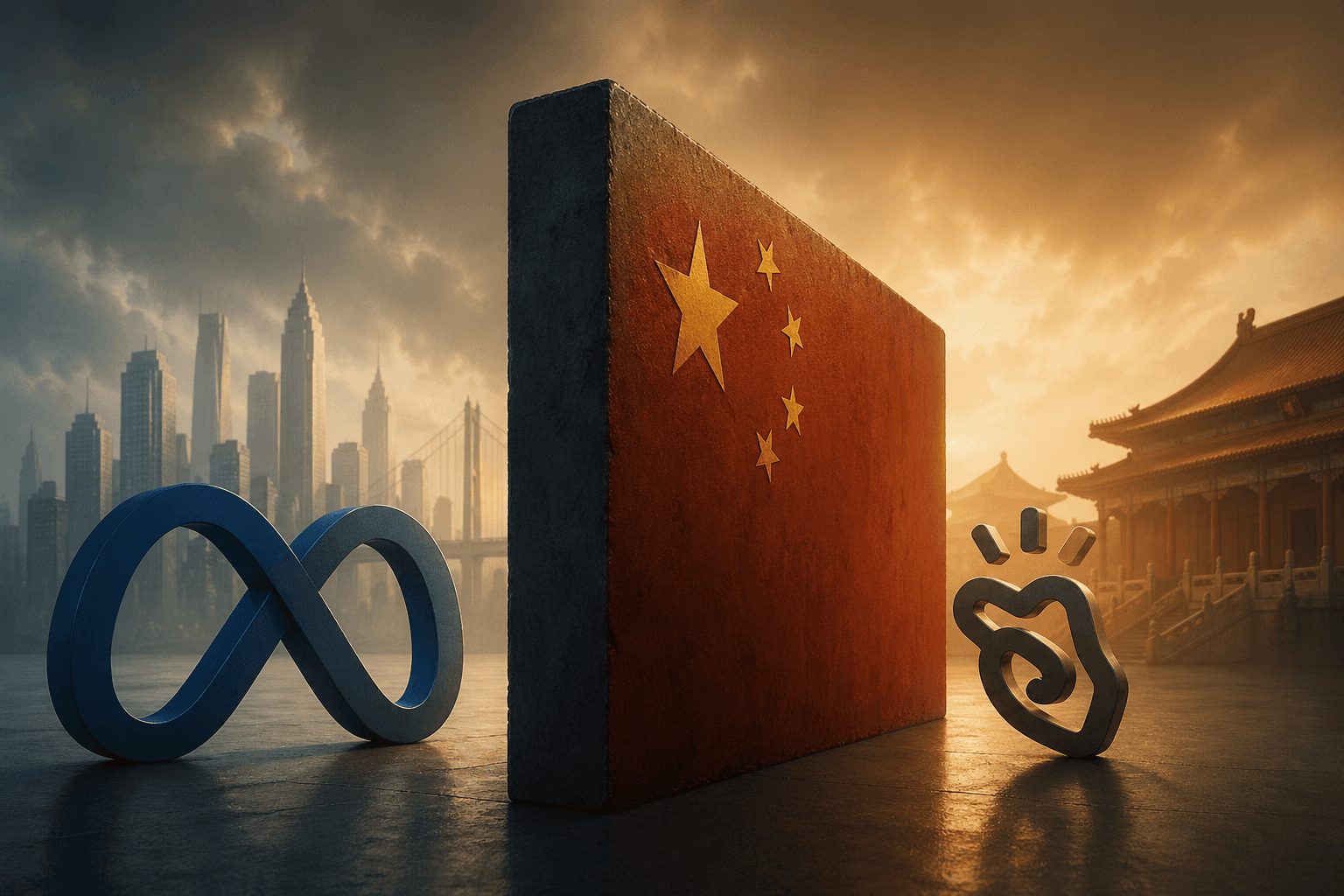
The story of a Singapore relocation, a done deal, and a very deliberate message from Beijing to every Chinese AI founder alive.
by Kasun Illankoon, Editor in Chief at Tech Revolt
[For more news, click here]
Beijing did not block Meta's acquisition of AI firm Manus because it posed a genuine threat to Chinese national security. It blocked it because it could. And because the message that sends is far more valuable to China than any single $2 billion deal.
Let us be direct about what happened here, because the headlines have largely buried the lead.
In December, Meta quietly closed a deal to acquire Manus, the AI automation startup that had earned a near-mythic reputation in tech circles for its autonomous agent capabilities. The price tag: approximately $2 billion.
Manus is not a household name outside of AI circles, but within them it had become something of a phenomenon. Founded in 2024, the Singapore-based startup built what it called a 'general-purpose AI agent', essentially software that can independently plan, reason, and execute complex multi-step tasks without needing a human to hold its hand at every stage.
Think of it less like a chatbot and more like a digital employee: one that can browse the web, write code, manage files, fill out forms, and complete entire workflows from start to finish on its own. In the world of AI agents, that is a genuinely difficult thing to build well, and Manus built it fast. The company launched its first product in March 2024 and hit $100 million in annual recurring revenue by December of the same year, just eight months later.
That kind of trajectory does not go unnoticed. It is precisely the sort of capability Meta has been hunting for as it races to embed AI deeply into its consumer and enterprise products, from its Meta AI assistant to its broader business automation ambitions.
The team, originally developed with deep ties to Chinese talent and research ecosystems, had relocated its operational base to Singapore.
That relocation was not accidental. It was strategic. Manus's founders and backers understood the geopolitical weather well enough to know that a Chinese-linked AI firm being acquired by the world's largest social media company would draw scrutiny. Singapore offered distance, neutrality, and a credible claim that this was no longer a "Chinese" company in any regulatory sense.
By the time China's regulators moved to block the acquisition under national security grounds, Meta had already integrated Manus into its operations. The deal was done. The team was embedded. And then Beijing said no.
So here is the first thing worth understanding: China blocked a deal that had already happened, involving a company that had physically moved itself to another country, specifically to avoid this outcome. That is not a routine regulatory intervention. That is a statement.
There is a persistent fantasy in Silicon Valley and among global tech investors that corporate geography is destiny. Move your headquarters, reincorporate in a friendlier jurisdiction, hire a local CEO, and suddenly you are no longer subject to the political preferences of the country where your founders were born and educated and where your intellectual DNA was formed.
China has now, very publicly, rejected that fantasy.
The Manus case makes plain that Beijing does not evaluate companies purely on where they are registered. It evaluates them on where they came from, who built them, what they know, and who is trying to buy them. A Singapore address does not change the fact that Manus's core capabilities were developed by people who trained inside the Chinese research ecosystem. In Beijing's view, that makes the underlying intellectual property a national asset, regardless of what a corporate filing says.
This is, legally speaking, an extraordinary claim. Most countries do not assert jurisdiction over companies that have left their shores, restructured under foreign law, and sold themselves to foreign buyers. China is asserting exactly that. And the international community, at least for now, appears to have no clear mechanism to push back.
Meta is a $1.4 trillion company. A $2 billion deal falling apart is uncomfortable, not catastrophic. Mark Zuckerberg's AI ambitions will survive this setback. Meta will find other targets, develop capabilities in-house, or simply wait for the geopolitical climate to shift.
The real audience for China's intervention is not Meta. It is every Chinese AI founder currently sitting in a co-working space in Singapore, or London, or San Francisco, building something world-class and quietly entertaining acquisition conversations with American tech giants.
The message Beijing is sending is precise and chilling: "Build here. Stay here. Or face the consequences."
China has spent years cultivating a domestic AI ecosystem, pouring state resources into research institutions, offering tax incentives to founders who keep their work onshore, and building national champions in large language models, computer vision, and autonomous systems. The strategy has been to acquire talent and intellectual property domestically, develop it with state backing, and then, crucially, lock the door behind it.
Blocking the Manus deal is the door-locking in real time.
The uncomfortable truth that the technology industry has been reluctant to fully absorb is this: the global AI market is no longer truly global. It has fractured, and that fracture is accelerating.
American AI firms operate under export controls that limit what chips and software they can sell to Chinese entities. Chinese AI firms operate under informal but increasingly explicit pressure not to exit to Western acquirers. The result is two separate AI development tracks, increasingly sealed off from one another, each optimising for different values, different security architectures, and different geopolitical masters.
For years, the thesis was that talent was the universal solvent. That a brilliant researcher was a brilliant researcher, that ideas moved freely, and that the best technology would ultimately find the best home regardless of national borders. The Manus situation demolishes that thesis with considerable force.
Talent that was trained in China, that built IP in China, that was then moved to Singapore to look more palatable to Western acquirers? China considers that talent and that IP to still belong to China. Full stop.
If you are a Chinese national who has built something genuinely valuable in AI, you now face a set of choices that did not exist with the same clarity five years ago.
You can build domestically and accept the constraints, the surveillance, the party-alignment requirements, and the ceiling on what international expansion looks like. You can relocate and genuinely sever ties, understanding that this is a long and uncertain process with no guarantee China will accept the severance. Or you can try to straddle both worlds, operating internationally while maintaining Chinese roots, and accept that you are permanently exposed to exactly the kind of intervention that just swallowed $2 billion of Meta's money.
None of these options are clean. All of them reflect a world in which the decision to build AI is now, inescapably, a political decision.
What is China actually trying to achieve here? Not the defeat of Meta specifically, and not the humiliation of Manus's founders. The goal is structural.
China wants to be the dominant global power in artificial intelligence by 2030. That is not speculation; it is stated policy. To achieve that goal, China needs to retain its best people, protect its most valuable intellectual property, and prevent Western technology companies from simply purchasing their way to supremacy by acquiring Chinese-developed capabilities.
Every acquisition that Beijing blocks is a capability that stays within China's sphere of influence. Every Chinese founder who thinks twice about selling to an American acquirer is a founder who might instead partner with a domestic champion. Every Manus-style situation that plays out publicly is a lesson for the next hundred Chinese AI founders watching from the sidelines.
China is not playing the short game here. It is building walls, and it is building them deliberately.
The Meta-Manus deal did not fail because Manus posed a national security risk. It failed because China has decided, at the highest levels of government, that the era of Chinese AI talent freely exiting to Western acquirers is over.
The Singapore relocation did not work. The December close did not protect the deal. The $2 billion did not change the outcome. What changed the outcome was Beijing deciding that this moment, this deal, this company, was the right place to draw a very visible line.
Geopolitics just swallowed a $2 billion deal whole. Anyone who thinks this is an isolated incident is not paying attention.
The global AI race is no longer just a technology competition. It is a territorial dispute. And the borders are being drawn right now.
Related Articles


