

Technology
Sep 25, 2026
Technology
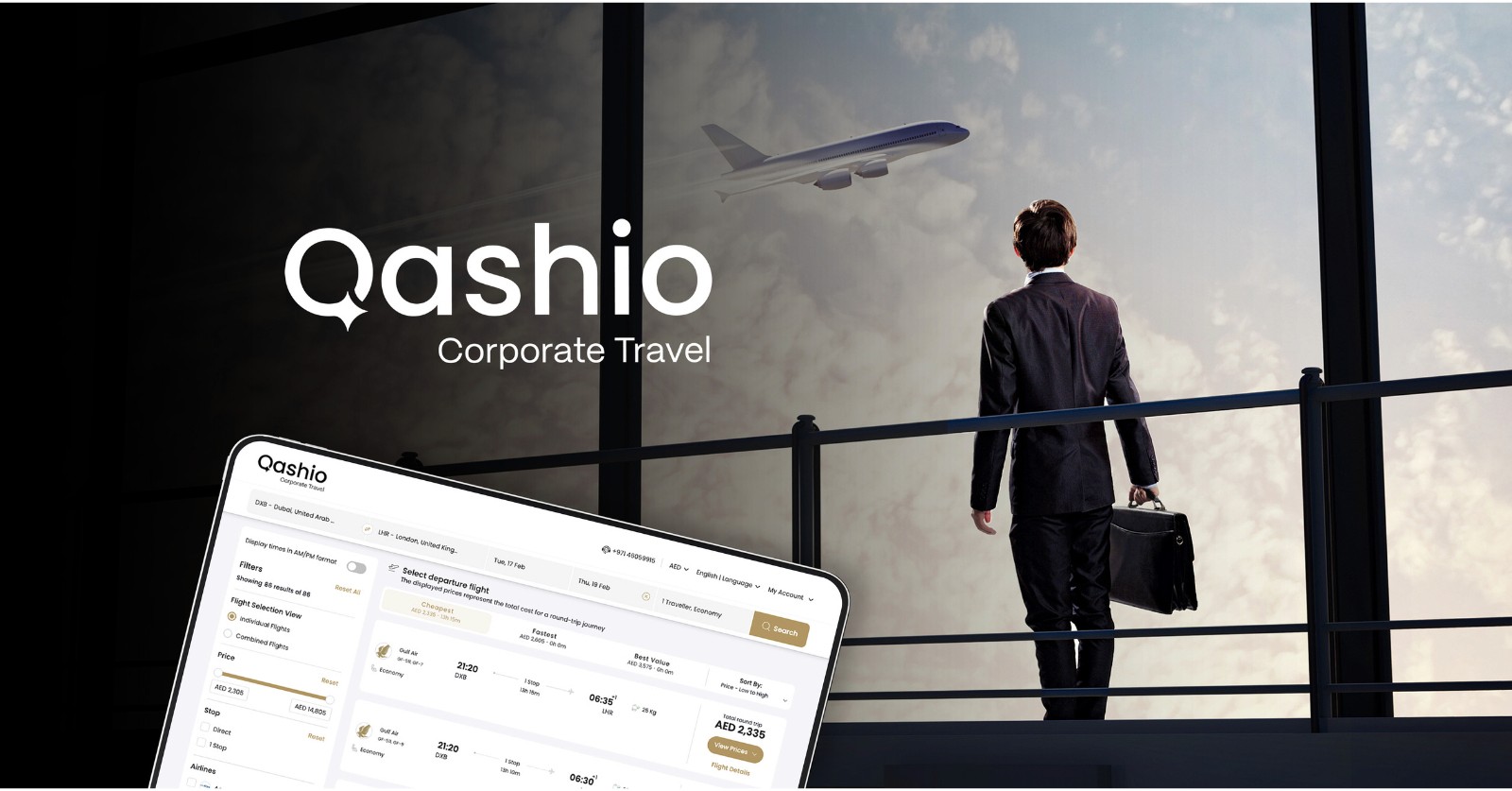
Business travel in the Middle East is heading toward $270 billion by 2030. Almost none of that spend is under real financial control. Qashio's new Corporate Travel platform is a direct bet that the era of fragmented booking tools, lost receipts, and policy workarounds is finally over.
[For more news, click here]
Picture the average corporate travel experience from a finance team's perspective. An employee books a flight through one tool, a hotel through another, pays with a personal card because the company card does not work internationally, submits a receipt two weeks later in a format nobody can read, and the whole thing gets reconciled — loosely, manually — sometime before the quarter closes. Multiply that by hundreds of employees across multiple markets and what you have is not a travel programme. It is an administrative emergency that finance teams have quietly accepted as a permanent condition of doing business.
Qashio, the spend management platform that has built one of the largest footprints in the MENA region, is launching Qashio Corporate Travel this month, and the timing is deliberate. With Eid and summer travel season approaching, the company is introducing a product that combines flight and hotel booking, company card issuance, expense categorisation, receipt management, and real-time reconciliation into a single platform. The idea is straightforward but has proven surprisingly difficult to execute: one system, one dashboard, every dollar of travel spend accounted for before the trip is even over.
Corporate travel is one of the most persistent blind spots in enterprise finance. It sits in an awkward space between HR policy, operations, and finance — which means it often ends up owned by none of them effectively. Employees book what is convenient. Finance teams reconcile what they can. The gap in between, filled with personal card charges, out-of-policy bookings, and missing documentation, represents a significant and largely unmeasured cost for most organisations.
In MENA, the scale of that problem is about to get considerably larger. Business travel spending across the region is projected to grow at 8.3% annually and reach $270 billion by 2030. That growth is being driven by economic diversification, cross-border trade activity, and the expansion of multinational businesses into and out of Gulf markets. The demand is real and it is accelerating. The infrastructure to manage it has not kept pace.
"Corporate travel has traditionally been fragmented, manual, and difficult to control," said Armin Moradi, Chief Executive Officer and Founder of Qashio. The observation is not controversial. What is more interesting is what Qashio is doing about it.
The product works from a deceptively simple premise: the same platform a finance team already uses to manage cards, expenses, and approvals should also be where travel gets booked. Not a separate tool that integrates with the expense system. Not a third-party travel management company whose data arrives in a monthly report. The same platform, with the same real-time visibility, the same policy controls, and the same reconciliation logic that applies to every other category of company spend.
In practice this means employees can book from a global inventory of more than 200 airlines and 1.5 million hotels, pay with their Qashio company card or an alternative payment method, and have every transaction automatically categorised and reconciled without any manual intervention from the finance team. Price-matched fares and exclusive corporate rates are built into the booking layer. A dedicated post-sale support centre handles inventory management after purchase, covering the changes, cancellations, and rebooking scenarios that typically generate the most friction in corporate travel programmes.
Finance teams, meanwhile, get something they rarely have with corporate travel: complete real-time visibility. Every booking, every transaction, every receipt sits in the same dashboard as the rest of company spend. The reconciliation that normally takes days or weeks at month-end becomes continuous rather than periodic. Companies also earn up to 3% rebates on travel spend and accumulate Qashio Points on every booking, turning a cost centre into something that at least partially offsets its own expense.
The platform is available immediately to all customers with no usage fees, which removes one of the adoption barriers that has slowed enterprise software launches in this category before.
Qashio Corporate Travel is not launching in isolation. It arrives as part of a broader expansion story that has been quietly building momentum over the past year. The company recently opened its European headquarters in Dublin, adding to existing offices in Dubai, Abu Dhabi, Saudi Arabia, and Jordan. It now serves thousands of enterprise and mid-market customers across the Middle East, the EU, and the UK, which means it is operating across regulatory environments and financial infrastructure systems that vary considerably in their maturity and requirements.
That geographic spread matters for understanding what Qashio is actually building. The company is not positioning itself as a regional fintech with global ambitions — it is positioning itself as an international spend management platform that originated from the region. The distinction is meaningful. MENA markets have specific characteristics: high cash dependency that is being actively dismantled by national cashless strategies, rapid digital transformation agendas, and a business travel culture shaped by the hub-and-spoke connectivity of Gulf aviation. A platform built with those dynamics at the centre is different from a Western enterprise travel tool retrofitted for the region.
The cross-border nature of the product also reflects something important about where the compliance and policy burden in corporate travel actually sits. For companies operating across multiple markets, the problem is not just that travel spend is fragmented within a single country. It is that booking systems, card infrastructure, expense policies, and reporting requirements all vary by market, and employees navigate that complexity by defaulting to whatever works — which usually means personal cards, informal processes, and retrospective approvals. Bringing all of that into a single policy-led platform, with controls that apply regardless of where the booking is made or how it is paid for, addresses the problem at the root rather than the symptom.
There is a pattern worth noticing across the spend management and corporate travel categories right now. The tools that are gaining ground are not the ones that do one thing better than the previous generation of software. They are the ones that collapse the number of systems a finance team has to manage. The fragmentation tax — the cost in time, errors, and lost visibility that comes from running expense management in one tool, card management in another, and travel in a third — has become large enough that consolidation is now the primary value proposition, not feature differentiation.
Qashio's move into corporate travel is a direct expression of that logic. The company has spent years building the underlying infrastructure for spend control: the card programme, the expense engine, the approval workflows, the reporting layer. Corporate travel is the category that sits most awkwardly outside that infrastructure for most companies, and therefore represents the largest remaining gap in the consolidated spend management story.
With $270 billion in regional business travel spend on the horizon and a platform now capable of capturing it within the same financial framework as every other company expense, the gap is getting smaller. For finance teams across the region, that is not a minor product update. It is a meaningful change in what controlled, visible, policy-compliant corporate spending can actually look like in practice.
Related Articles


