
AI
Sep 16, 2026
At the inaugural GITEX AI Central Asia & Caucasus, the landlocked nation unveiled an ambitious pledge to become a fully digital state — and positioned itself as the unlikely bridge between Gulf capital and Eurasian engineering talent.
by Kasun Illankoon, Editor in Chief at Tech Revolt
On a warm spring morning in Almaty, Kazakhstan's commercial capital, something unprecedented was taking shape inside the sprawling Atakent International Exhibition Centre. Delegations from Abu Dhabi, Seoul, and Berlin were sharing exhibition floors with Almaty startups and Astana government officials.
On the main stage, one of the world's most influential voices in artificial intelligence, Kai-Fu Lee, the venture capitalist and A.I. pioneer, was sitting down for talks with Kazakhstan's head of state. For a country that many in Silicon Valley struggle to locate on a map, the optics were deliberately, pointedly global.
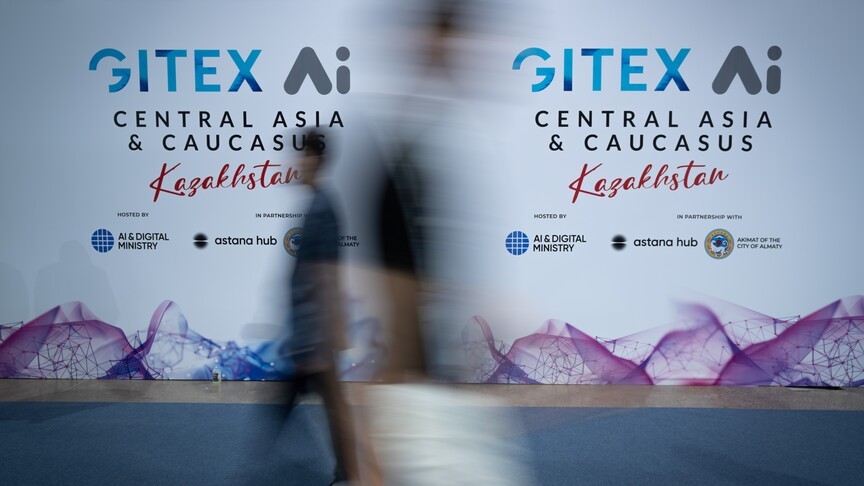
This was the inaugural GITEX AI Central Asia & Caucasus, held May 4–5 under the patronage of President Kassym-Jomart Tokayev and hosted by Kazakhstan's Ministry of Artificial Intelligence and Digital Development. The two-day summit drew more than 600 exhibitors from over 60 countries and upwards of 10,000 participants, making it, by any measure, the largest technology gathering ever staged in the region.
The headline announcement came from President Tokayev himself: Kazakhstan would become a fully digital state within three years. It was a timed, public commitment delivered on the GITEX stage — not tucked into a government white paper.
The choice of venue was deliberate. By making the pledge here, in front of investors, technologists, and international media, Tokayev was doing something Central Asian governments have historically been reluctant to do: submitting to a deadline.
The ambition on display went beyond rhetoric. Tokayev was presented with the live capabilities of the Al-Farabium supercomputer — named for the 9th-century Central Asian philosopher — now powering an A.I. assistant deployed in the contact centers of Kazakhtelecom, the country's dominant telecommunications operator. It was the first major public demonstration of the machine driving a real commercial product, and it drew a palpable shift in energy in the room.
Perhaps more consequential for the long term was the unveiling of the Data Center Valley project in Ekibastuz, a coal-mining city in Kazakhstan's Pavlodar region, which sits atop one of the largest coalfields in the world and already supplies electricity to a significant portion of the country.
The planned campus — with an energy capacity of up to one gigawatt — is designed to become the largest data center facility in all of Central Asia. Presight AI, the Abu Dhabi-based intelligence firm operating across 17 countries, announced its interest in joining the project at the summit. If realized at scale, Ekibastuz could do for Central Asian cloud infrastructure what Iceland did for European data centers: offer cheap, abundant energy as a competitive moat.
Undergirding much of the summit's energy was a subtler but significant geopolitical current: the deepening integration between Gulf capital and Central Asian engineering talent. GITEX itself — born in Dubai and long the flagship technology event of the Arab world — is the most visible symbol of that convergence. Its decision to plant a flag in Almaty is not merely a branding exercise. It reflects a view, increasingly common in Abu Dhabi and Riyadh, that the next generation of digital growth will not emerge from saturated Western markets but from corridors stretching between the Gulf and Eurasia.
UAE-Kazakhstan CEPA negotiations running in parallel to the summit gave that thesis institutional form. On the fintech side, UAE-based PayRow and Central Asian payments infrastructure firm 8B announced a partnership to build a unified payment interface — with ambitions to connect the national QR payment systems of Kazakhstan, Uzbekistan, and Kyrgyzstan into a single checkout experience by 2027. It was the kind of quiet, plumbing-level announcement that rarely generates headlines but frequently reshapes markets.
For all its national ambitions, much of what was announced at GITEX Kazakhstan was centered on Almaty specifically, a city of more than two million that already accounts for roughly half of the country's venture capital activity and is home to over 1,500 startups. Plans were unveiled for the Almaty AI Hub, a 10,000-square-meter facility dedicated to technology companies, set to open this November. A larger long-term initiative, the Almaty AI Park, spread across a seven-hectare site, is also in development to attract international firms and support sustained tech growth.
The smart city thread was equally prominent. Tokayev highlighted the success of Presight AI's smart city infrastructure in the capital, Astana, and announced that similar systems would expand to Almaty. For a megacity still navigating rapid urbanization and traffic congestion, the prospect of AI-driven urban management has practical stakes — not merely symbolic ones.
Kazakhstan already ranks first in Central Asia on the IMF's A.I. preparedness index and places in the global top ten for online government services, according to the United Nations. Its "Digital Kazakhstan" roadmap targets full e-government adoption and 70 percent industrial automation. The country also sits in a region — Central Asia and the Caucasus — projected to grow at roughly 4.7 percent annually through 2026, with IT services expected to reach $5.6 billion by 2029.
The funding picture is improving too. Venture capital flows into the region reached $95 million in 2024, modest by global standards but meaningfully ahead of where they were just five years ago. A new coordination office at Astana Hub now connects government agencies, startups, and research institutions; a Defense Tech IT Park in Almaty is showcasing advanced local solutions. The architecture of an ecosystem is being assembled, piece by piece.
Organizers and officials confirmed that talks are already underway to make GITEX AI Central Asia & Caucasus a permanent annual fixture — and to bring other regional events to Kazakhstan. For a country that spent three decades after independence quietly building its institutions, the impulse to now announce, convene, and invite the world to watch is itself a kind of statement. The age of the digital steppe, it seems, is no longer a distant projection. It has a date.
Related Articles