

AI
Sep 16, 2026
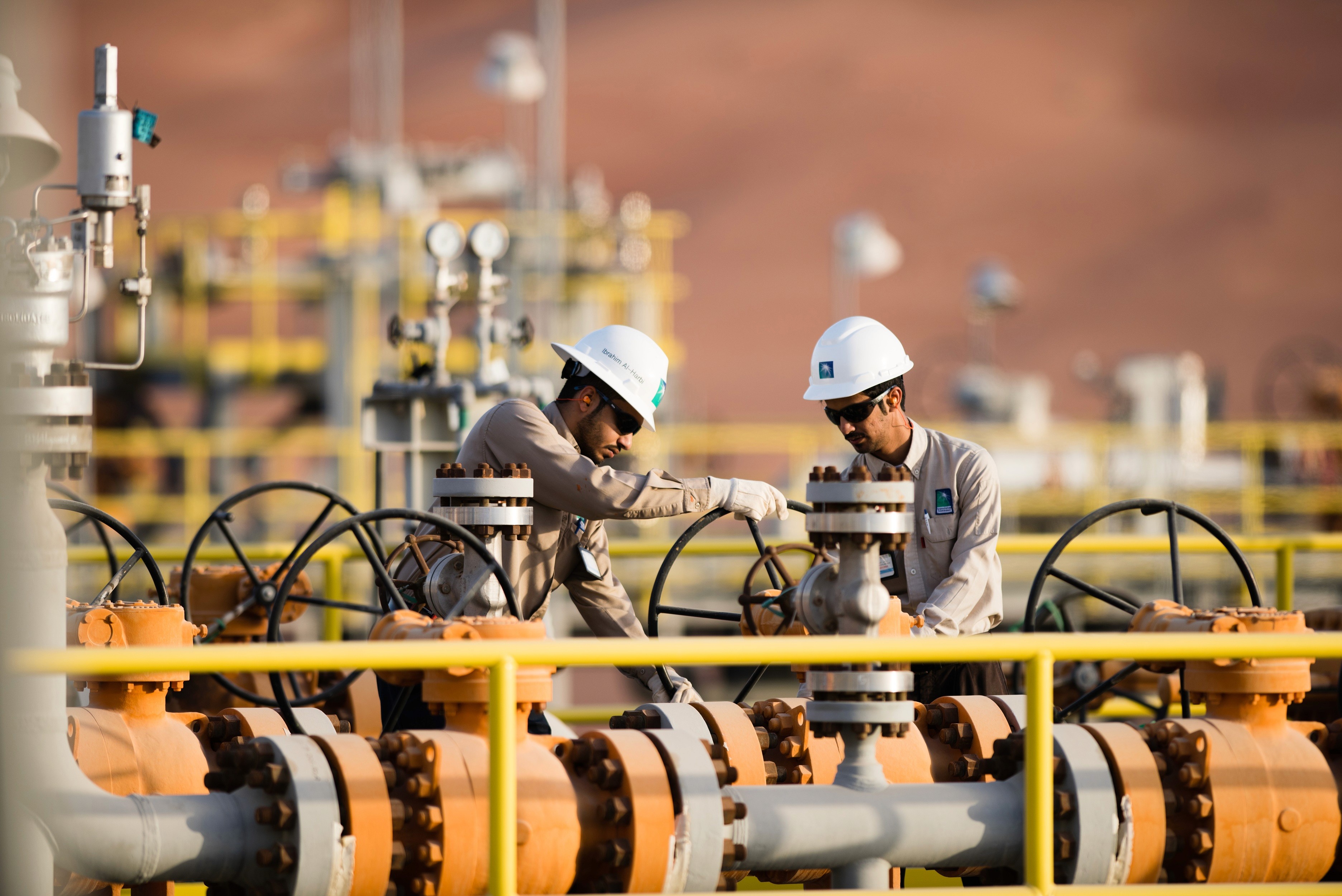
Aramco and Emerson have quietly built one of the most ambitious industrial AI deployments in energy history. It is already predicting refinery yields with near-perfect accuracy, and it is only getting started.
by Kasun Illankoon, Editor in Chief at Tech Revolt
There is a version of the artificial intelligence story that plays out in conference rooms and keynote presentations, full of promises about transformation and disruption. And then there is the version that plays out quietly inside some of the world's most complex industrial infrastructure, where the stakes are measured not in engagement metrics but in barrels of oil, margin forecasting, and the difference between a refinery running at optimal efficiency and one bleeding value through avoidable imprecision.
Aramco and Emerson are firmly in the second version. The two companies announced this week the successful deployment of an AI-driven optimization solution across Aramco's global refining network, and the details are considerably more significant than the typical tech-industry fanfare suggests.
The core of the deployment is something called Aspen Hybrid Models, a technology developed by Emerson's Aspen Technology business that blends first-principles engineering models with purpose-built industrial AI. The result is a planning tool that can capture the deeply nonlinear relationships between feedstock inputs, operating conditions, and yield outputs — the kind of complexity that has historically required armies of engineers making constant manual adjustments to keep refinery plans aligned with reality.
What Aramco and Emerson built together is, by any measure, a genuinely large-scale industrial AI system. The integration has produced one of the world's largest multi-site, multi-period optimization models, spanning Aramco's global refining network across multiple geographies and operating conditions simultaneously.
The system has already achieved yield and quality prediction accuracy of up to 98.5% in key refinery units. That number matters because the gap between a planning model and actual plant performance is where value leaks out of refining operations at enormous scale. For a company the size of Aramco, even marginal improvements in that accuracy translate into hundreds of millions of dollars in recovered value annually.
To understand why this deployment is notable, it helps to understand what refinery planners are actually dealing with. A modern refinery is not a static machine that processes a fixed input into a predictable output. It is a dynamic, constantly shifting system where feedstock quality varies, unit performance drifts over time, market prices change the relative value of different output streams, and the interactions between dozens of process units create nonlinear effects that simple models cannot capture.
Traditional planning models have historically relied on linear approximations of these relationships, which work reasonably well much of the time but break down precisely when accuracy matters most, when feedstock composition shifts, when units are operating near their limits, or when planners are trying to optimize across multiple sites simultaneously.
Aspen Hybrid Models address this by combining rigorous first-principles simulation, which encodes the underlying chemistry and physics of refinery processes, with machine learning trained on thousands of converged simulation cases built from actual plant data. The hybrid approach captures nonlinearity that pure data-driven models struggle with, while remaining grounded in physical reality rather than simply pattern-matching historical data.
The practical result, in Aramco's case, is more precise feedstock blending, reduced gaps between planned and actual plant performance, and improved margin forecasting accuracy across a network of global assets. Engineers are spending less time on manual model tuning and more time on decisions that actually require human judgment.
"We are committed to leveraging innovative technologies for smarter, more efficient refining optimization," said Ahmad Alkudmani, director of the global optimizer department at Aramco. "With improved model accuracy, we are enhancing planning decisions, reducing the manual adjustments required from our engineers, and uncovering new value across our global assets."
One of the more telling signals in this announcement is where Aramco is taking the technology next. Current efforts are focused on expanding the hybrid modeling approach to hydrocracker units across Aramco's assets. That is a significant move.
Hydrocrackers are among the most complex and capital-intensive units in a modern refinery, converting heavy residual oil into higher-value lighter products. Getting planning models right for hydrocrackers is notoriously difficult because the reaction chemistry is highly nonlinear and the unit economics are sensitive to both feedstock quality and operating severity. If Aspen Hybrid Models can deliver the same accuracy gains in hydrocracker planning that they have demonstrated in Continuous Catalyst Regeneration and Platformer units, the economic case for the broader deployment becomes very hard to argue against.
The choice to expand rather than consolidate is the clearest indicator that the initial results have been convincing. Companies at Aramco's scale do not roll out technology across additional high-stakes units because the press release looked good. They do it because the numbers are real.
The Aramco-Emerson deployment is part of a broader and underreported story about where artificial intelligence is actually delivering measurable value in 2025. While the consumer AI narrative has focused on chatbots, image generators, and productivity tools, the more durable economic value is being created in industrial settings where AI is solving problems that have been intractable for decades.
Refinery optimization is a category where the combination of domain expertise, high-quality simulation data, and advanced machine learning can produce outcomes that neither engineering models nor data science alone could achieve. Emerson's Aspen Technology business has spent decades building the domain knowledge and first-principles modeling infrastructure that makes this kind of hybrid approach possible. The AI layer is not a shortcut around that expertise — it is a force multiplier on top of it.
"This deployment of AI-driven Aspen Hybrid Models to optimize complex, multi-site, multi-period planning workflows demonstrates the tangible value of combining deep domain expertise with advanced AI," said Claudio Fayad, chief technology officer of Emerson's Aspen Technology business.
That framing is worth taking seriously. The companies that will capture lasting value from industrial AI are not the ones deploying off-the-shelf models on top of generic data. They are the ones that have spent years accumulating the domain-specific knowledge and calibrated simulation infrastructure that gives AI something real to work with.
For Aramco specifically, this deployment sits within a broader and ambitious digital transformation agenda. The company has been investing heavily in technology and data infrastructure as part of its long-term strategy to maintain operational leadership even as the energy transition reshapes demand dynamics globally.
Deploying AI at this scale, and doing it in refining operations rather than just in upstream exploration or corporate functions, suggests Aramco is serious about extracting every available efficiency gain from its existing asset base. In a world where the long-term trajectory of oil demand is genuinely uncertain, maximizing the margin and yield performance of the refining network is not merely an operational priority. It is a strategic one.
The partnership with Emerson gives Aramco a scalable, robust tool that maintains its accuracy across a wide range of operating conditions and geographies. That scalability matters because the real payoff of enterprise AI is not in pilot deployments. It is in the compounding effect of deploying accurate, reliable models consistently across an entire global network.
That is the ambition here. And based on what has already been achieved, the ambition looks well-founded.
Related Articles