

AI
Sep 25, 2026
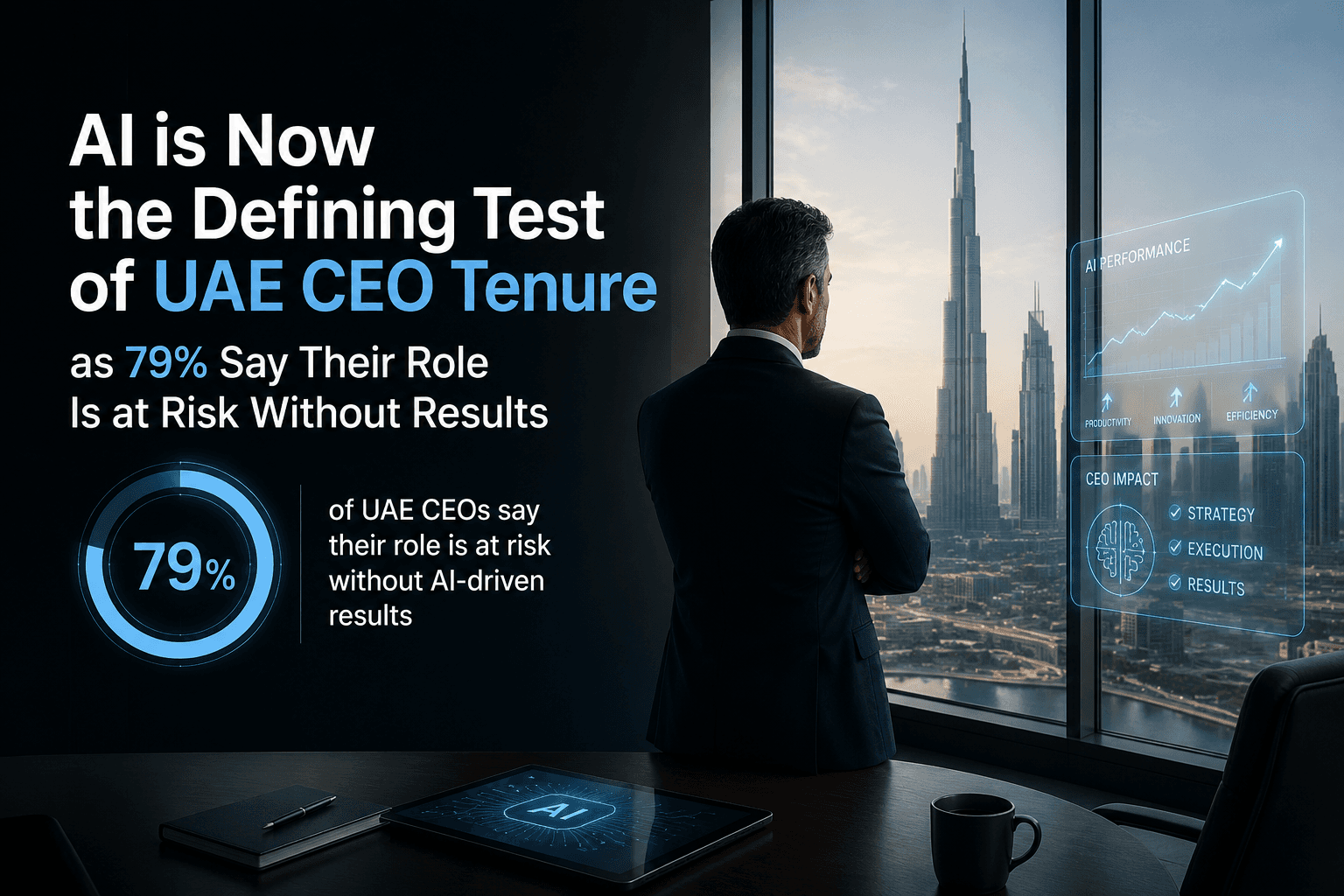
In boardrooms across Dubai and Abu Dhabi, a quiet reckoning is underway. Chief executives who once treated artificial intelligence as one item on a long strategic agenda have come to understand it as something far more personal: a direct test of whether they deserve to keep their jobs.
by Kasun Illankoon, Editor in Chief at Tech Revolt
[For more news, click here]
A sweeping new study published this week by Dataiku, an enterprise AI platform company, makes that pressure impossible to ignore. Conducted by Harris Poll across 900 CEOs in eight countries, the 2026 CEO Confessions Study finds that 79 percent of UAE chief executives believe their role is at risk if their organisation fails to deliver tangible business gains from AI by the end of this year. That is not a vague, long-horizon anxiety. That is a deadline.
The findings position the UAE at a striking distance from the rest of the world. Globally, CEOs are worried about AI. In the Emirates, they appear to be living with an acute, almost existential urgency about it.
Perhaps no statistic in the study is more arresting than this one: 23 percent of UAE CEOs believe the way their organisation is using AI today could jeopardise their long-term legacy. That figure is more than double the global average. It suggests that for a significant portion of Emirati business leadership, the question is no longer whether AI will matter to their tenure but whether a misstep now could define how they are remembered.
This reframing of AI as a legacy issue rather than merely a performance metric signals something important about where corporate culture in the UAE has arrived. When executives begin thinking in terms of historical reputation, the strategic becomes existential.
More than half of UAE CEOs surveyed, 53 percent, say that experience leading a successful AI strategy will become the top criterion that boards use when appointing new chief executives within two years. If that prediction is accurate, the skills that defined a generation of business leadership, financial acumen, operational discipline, stakeholder management, will be subordinate to a single, harder-to-fake credential: the ability to make AI actually work.
What is notable about the UAE's AI moment is not just the pressure, but the response to it. Three-quarters of UAE CEOs say their involvement in AI-related decisions has increased over the past year. More than half, 55 percent, identify themselves as the single most influential stakeholder in determining their organisation's AI direction, well ahead of IT, data, or business leaders.
That is a meaningful shift. For years, AI strategy in large organisations was largely the province of chief technology officers or newly minted chief data officers, roles created precisely to give boards someone to blame when algorithms went wrong. The Dataiku data suggests that in the UAE, that delegation is ending. CEOs are not just signing off on AI budgets; they are driving the decisions.
Whether that is wise is an open question. Centralising AI authority in the office of the chief executive can accelerate decision-making and signal commitment. It can also create bottlenecks and concentrate accountability in leaders who may not have deep technical fluency. The study nods at this tension. While 73 percent of UAE CEOs say they trust their governance frameworks even if their job were on the line, the UAE ranks lowest globally in confidence in explaining AI-driven decisions to regulators or courts. Trust and transparency, it turns out, are not the same thing.
The pressure UAE chief executives are feeling does not originate entirely from within. Nearly six in ten, 59 percent, say they feel board pressure to deliver measurable AI outcomes. What makes that figure particularly notable is what comes alongside it: 90 percent of those same CEOs believe those expectations are realistic. They are not pushing back on the demands being made of them. They are internalising them.
Investor expectations are also sharpening. Seventy-six percent of UAE CEOs say AI strategy and execution are important to investors. Three-quarters believe a chief executive could be removed from their role in 2026 due to a failed AI strategy or a high-profile AI-driven crisis. That last category, the AI-driven crisis, represents a newer and perhaps more treacherous form of reputational risk. A botched earnings forecast is recoverable. An AI system that discriminates, hallucinates, or fails publicly is a different kind of wound.
"Every enterprise now has access to powerful AI. The differentiator is whether they can turn that power into reliable business decisions," said Florian Douetteau, CEO and co-founder of Dataiku. "That is the cognitive dissonance happening in the C-suite right now: CEOs are staking their jobs on AI, but still questioning its outputs and struggling to control the systems they say they own. The companies that close that gap will be the ones building AI worth being accountable for. That is what separates a bet from a business."
For all the momentum around AI in the UAE, the study surfaces an important counterweight: fear of failure is slowing things down. Forty-four percent of UAE CEOs say their organisations have delayed or cancelled AI initiatives due to concerns about potential failure. That is a significant figure, and it sits uneasily alongside the urgency expressed elsewhere in the same data.
The tension is not irrational. Chief executives who know their legacy depends on AI outcomes have every reason to avoid a high-profile collapse. But caution and results are not easily reconciled when a deadline is involved. If the clock runs to the end of 2026, and roughly half of organisations are pausing or retreating from initiatives, the window for meaningful delivery is narrower than it appears.
There is also a structural vulnerability lurking in the data. More than four in ten UAE CEOs, 43 percent, say their organisation would face significant risk if the so-called AI bubble were to burst. That language, once the province of sceptical economists and tech critics, has made it into the vocabulary of the executives most invested in AI's promise. It suggests that beneath the confidence, there is an awareness that the current moment may be fragile.
The study's most practically urgent finding may be the gap between governance confidence and governance capability. The UAE ranks lowest globally in CEO confidence around explaining AI-driven decisions to regulators or courts, even as 73 percent claim to trust their frameworks. Meanwhile, 41 percent of UAE CEOs say they have not challenged an AI vendor or platform decision made within their organisation over the past year.
That last figure is significant. AI vendors make consequential choices, about model design, data sourcing, and output calibration, that have downstream effects on the organisations using their products. A CEO who does not interrogate those choices is not really in control of the AI strategy they claim to own.
"The CEOs who succeed are those who treat governance as an accelerator, not a constraint," said Sid Bhatia, Area Vice President and General Manager for the Middle East, Turkey and Africa at Dataiku. "Organisations need the flexibility to adapt quickly, whether that means evolving models, changing vendors, or responding to new regulations without starting from scratch. Ultimately, this research suggests that in an environment where AI outcomes must be proven, explained, and defended, governance is becoming the foundation for both trust and long-term value."
The portrait that emerges from Dataiku's research is of a business leadership class that has absorbed the urgency of the AI moment more completely than almost anywhere else in the world, and is now grappling with the gap between that urgency and the messy, slow, and often disappointing reality of deploying AI at scale.
The UAE's CEOs are not naive. They are not treating AI as a magic solution. The 44 percent who have cancelled or delayed initiatives know, at least instinctively, that implementation is harder than vision. But knowing something is hard and having a clear path through it are different things.
What the data cannot tell us is whether the organisations feeling the most pressure are the ones best positioned to succeed, or simply the ones most exposed to failure. That answer will come not from a survey but from the quarterly results, board reviews, and regulatory encounters of the next twelve months.
In the UAE, at least, the test has already begun.
Related Articles


