
AI
Sep 22, 2026
Exclusive: JetBrains on Saudi Arabia’s AI Push, Developer Productivity and the Race for AI Governance
AI
The UAE has spent years declaring its ambitions in artificial intelligence. Now the institutions doing the actual work are starting to find each other.
[For more news, click here]
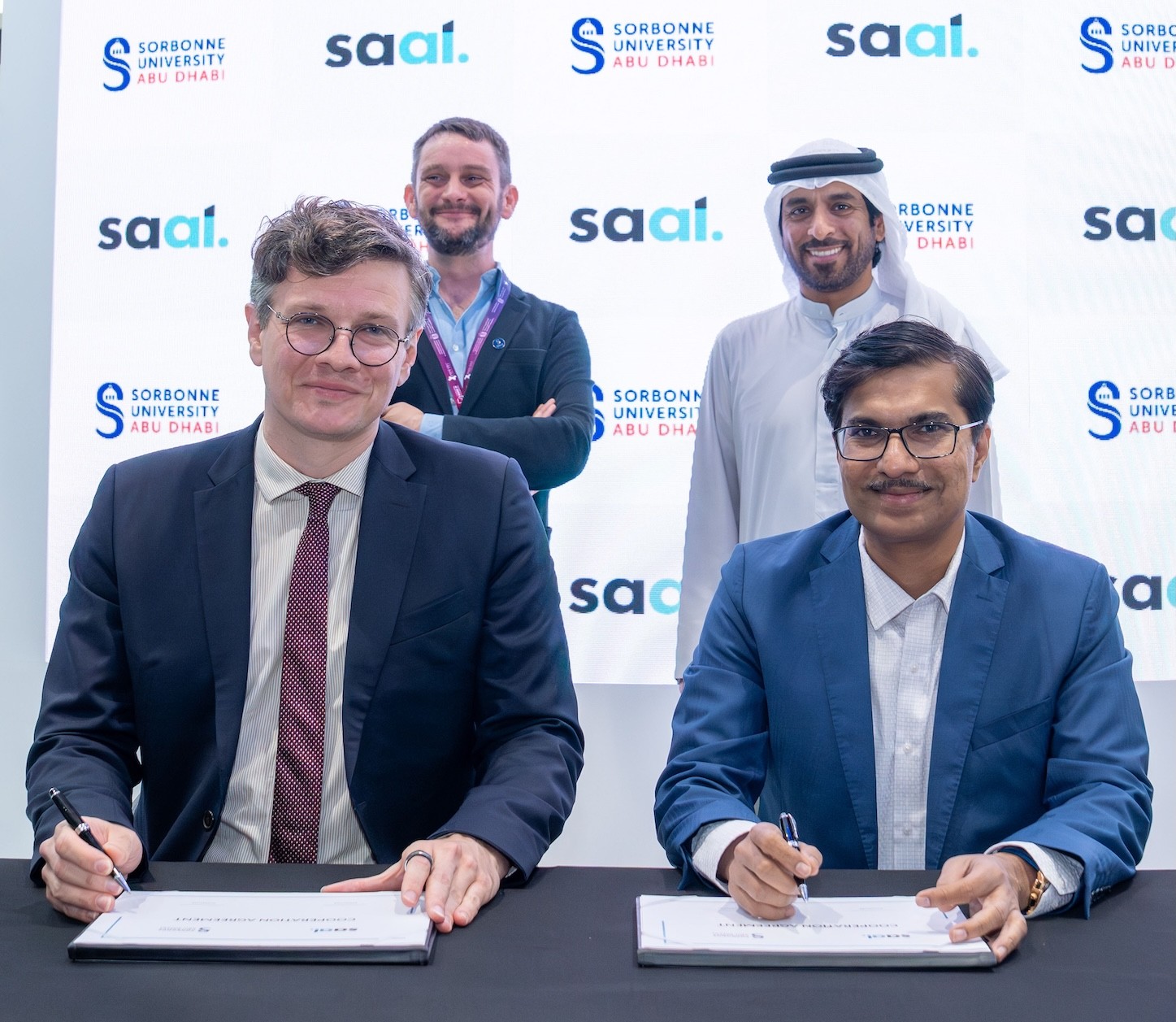
Sorbonne University Abu Dhabi (SUAD) and Saal.ai, a homegrown UAE AI and big data product company, have signed a Memorandum of Understanding to collaborate on research, innovation, and knowledge transfer across artificial intelligence, sovereign AI, and what the industry is increasingly calling Agentic AI. The agreement was announced at Make it in the Emirates 2026, a fitting stage for a partnership that is explicitly framed around building locally grounded AI capability rather than simply importing it.
The timing is not accidental. The UAE's national AI strategy has long identified sovereign infrastructure as a priority. What has been harder to build is the connective tissue between academic institutions generating research and industry players deploying AI at scale. This partnership is a direct attempt to close that gap.
For much of the past decade, AI sovereignty was treated as a policy aspiration rather than a technical challenge. Countries wanted control over their data, their models, and the infrastructure running beneath them, but the practical roadmap for getting there remained vague.
That is changing fast. Sovereign AI is now an engineering discipline as much as a political one, and the question is no longer whether countries will pursue it, but which institutions have the capabilities to make it real. In the UAE context, that means building AI systems that operate under local governance frameworks, serve national priorities, and do not require routing sensitive data through foreign infrastructure.
Saal.ai, built in the UAE, has been positioning itself within that infrastructure layer. The company focuses on enterprise AI platforms, sovereign AI infrastructure, and Agentic AI technologies, the latter referring to AI systems capable of operating autonomously to complete complex, multi-step tasks with minimal human intervention.
Agentic AI is widely regarded as the next frontier of enterprise AI deployment, and it raises the governance stakes considerably. Autonomous systems making consequential decisions on behalf of organisations require exactly the kind of locally grounded, auditable infrastructure that sovereign AI frameworks are designed to provide.
SUAD's contribution to the partnership runs through its Sorbonne Centre for Artificial Intelligence, known as SCAI, which serves as the institutional hub for the university's AI research and education agenda. The centre spans interdisciplinary research, specialised academic programmes including a Bachelor's in Mathematics with a specialisation in Data Science for Artificial Intelligence, and a broader mandate to produce talent that understands AI not just in theory but in operational, real-world contexts.
Dr. Xavier Fresquet, Head of SCAI, articulates the gap that partnerships like this are designed to fill: "Partnerships between academia and industry are becoming essential as AI technologies, including sovereign and agentic AI systems, rapidly expand across nearly all sectors of industry and society. At SCAI, we want our students not only to understand these technologies, but also to actively use them and engage with the AI-driven environments transforming professional practices worldwide."
He goes further on the research dimension: "From a research perspective, collaborations with industry partners are equally important in helping scale the models, architectures, and autonomous agent systems developed in our laboratories into robust, secure, and sovereign technological solutions."
That framing matters. Academic institutions produce foundational research, architectures, and theoretical models that often struggle to survive contact with production environments. Industry partners bring the infrastructure, the data, and the operational context to stress-test those models at scale. The MoU is designed to create structured pathways for that translation to happen, through joint research initiatives, AI innovation programmes, and formal knowledge exchange mechanisms.
The partnership also carries an explicit talent development mandate, and this may be its most consequential long-term dimension. Vikraman Poduval, CEO of Saal.ai, is direct about the priority: "This collaboration represents the next level of accelerating true sovereign AI capabilities in the UAE with self-reliance and full autonomy. By bringing together academic excellence and AI innovation, we are not only accelerating Agentic AI development but also ensuring that Emirati talent is at the center of this transformation."
The emphasis on Emirati talent reflects a recognised tension in the UAE's AI ambitions. The country has attracted significant foreign investment and expertise in technology, but sustainable AI sovereignty ultimately requires a local talent pipeline capable of building, maintaining, and governing these systems independently. Universities like SUAD are the upstream source of that pipeline, and connecting them structurally to companies deploying AI in production creates feedback loops that benefit both sides.
Poduval frames the commercial mission in similarly direct terms: "Our goal is to translate advanced AI research into real, impactful systems that serve national priorities and strengthen the UAE's leadership in trusted AI."
The partnership also aligns with SUAD's institutional Year of AI, reinforcing that this is not a one-off collaboration but part of a longer strategic commitment to positioning the university at the centre of the UAE's emerging AI ecosystem.
As sovereign AI moves from policy document to infrastructure project, the alliances being formed now between research institutions and technology companies will shape who controls the next layer of digital infrastructure in the region. This one is worth watching.
Related Articles


