

AI
Sep 23, 2026
AI
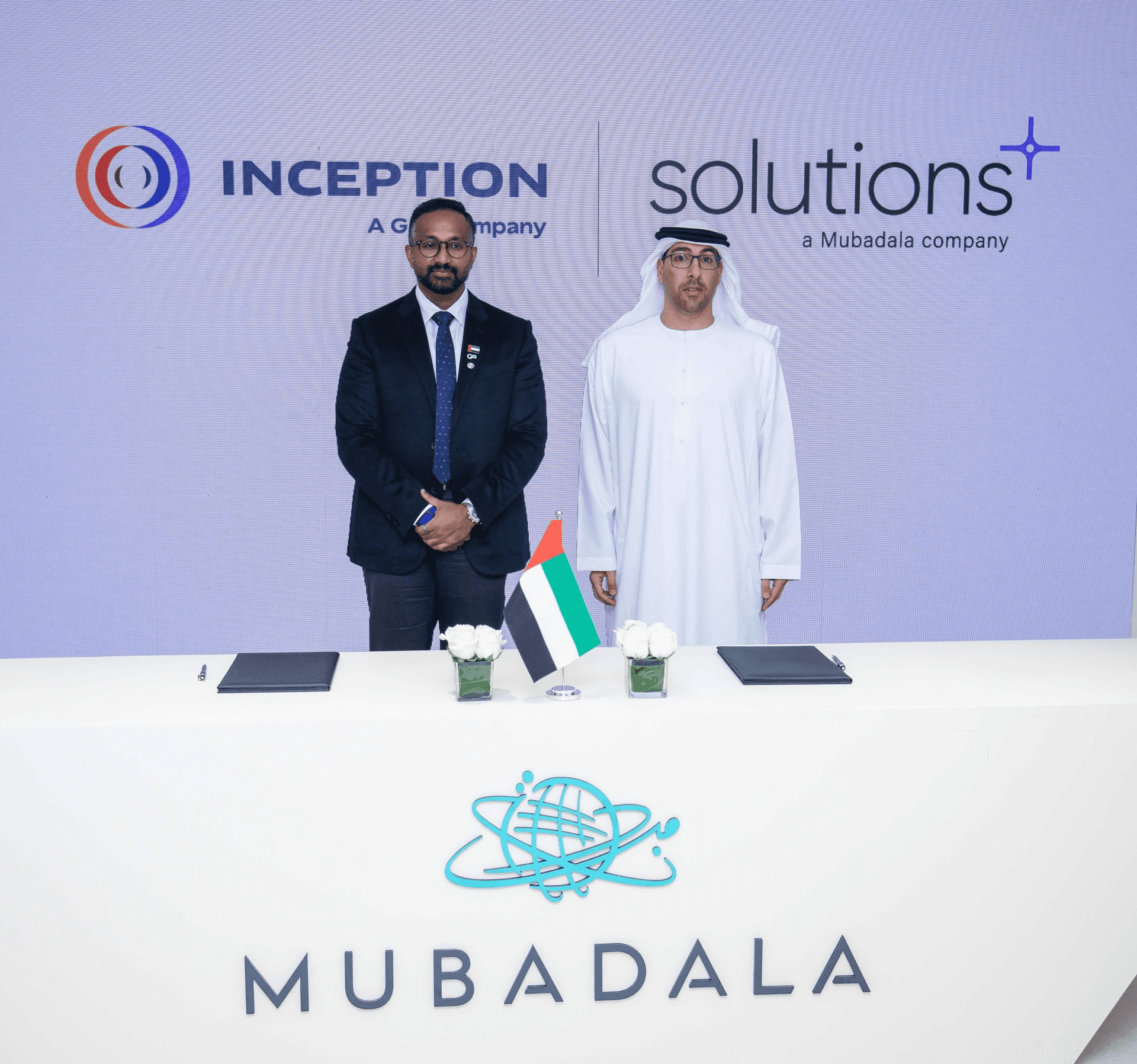
For years, the story of artificial intelligence in the Gulf has been told in announcements: grand partnerships, ambitious frameworks, sovereign strategies. Now, a different kind of deal is being struck, one that is less concerned with vision statements and far more focused on what happens after the ribbon is cut.
[For more news, click here]
Solutions+, a Mubadala company and one of the UAE's leading business consultancies specializing in digital solutions and shared services, has entered a strategic partnership with Inception, an artificial intelligence company operating under the G42 technology group, to accelerate the deployment of enterprise AI solutions across the Mubadala Investment Company ecosystem and the broader Gulf Cooperation Council market. The agreement was announced at Make it in the Emirates 2026 and signed by Nasir Al Nabhani, Managing Director of Solutions+, and Ashish Koshy, CEO of Inception.
The timing is deliberate. The GCC's corporate landscape is littered with AI pilots that never scaled, proof-of-concept projects that impressed in controlled conditions and then quietly stalled when confronted with the friction of real organizational life. The partnership between Solutions+ and Inception is structured specifically to address that failure mode.
"Enterprise AI adoption is accelerating, but many organizations are still working to scale beyond initial use cases and embed it into core operations," said Al Nabhani. "The priority now is execution, with a focus on integrating AI in a way that delivers consistent, measurable results. Through our partnership with Inception, we are combining advanced AI solutions with structured delivery and governance, enabling organizations to operationalize AI and achieve tangible business outcomes."
It is a notably grounded statement for an industry not known for understatement, and it points to something real about where the conversation around AI in the region has shifted. The question for Gulf enterprises is no longer whether to adopt artificial intelligence but how to make it work at scale, inside legacy systems, across regulated industries, and with the accountability structures that major institutional investors demand.
The architecture of the deal reflects how seriously both parties have thought through that challenge. Solutions+ will serve as the lead delivery and client interface for Inception's AI products across the Mubadala Group portfolio, as well as for UAE government and private sector clients. In practical terms, this means that Inception continues to develop and refine its AI technology while Solutions+ takes responsibility for the governance, project oversight, and industry-specific expertise required to move that technology from a software environment into a functioning business process.
It is, in effect, a division of labor designed to close the implementation gap that has frustrated enterprise AI adoption globally. AI companies often excel at building sophisticated models; they are less practiced at navigating the organizational complexity of a sovereign wealth fund's portfolio companies or the procurement requirements of a government ministry. Solutions+, by contrast, has spent years embedded inside the Mubadala ecosystem, understanding its structures and earning the institutional trust that enterprise technology deployment requires.
Koshy, for his part, acknowledged exactly that logic. "The Mubadala ecosystem sets a high bar for performance and accountability," he said. "Partnering with Solutions+ to serve that ecosystem is a validation of what Inception is built for: sovereign, enterprise-grade AI that delivers at scale. This collaboration gives us the structured delivery and governance layer to match our product capabilities and deepens our reach within one of the region's most significant institutional networks."
The word "sovereign" is doing meaningful work in that sentence. Across the GCC, questions of data sovereignty and national technological capability have become central to how governments and major institutions evaluate AI partnerships. The UAE's broader ambition, articulated repeatedly through initiatives like Make it in the Emirates, is not simply to consume AI developed elsewhere but to build, own, and govern the AI systems that will run critical national infrastructure.
Both Inception and Solutions+ sit within that strategic frame. Inception is backed by G42, the Abu Dhabi technology holding group that has positioned itself as the region's leading force in sovereign AI development. Solutions+ operates inside the Mubadala universe, itself one of the world's largest and most strategically active sovereign wealth funds. The partnership between them is, at one level, a commercial arrangement. At another, it reflects the UAE's systematic effort to build an integrated technology stack that keeps strategic capabilities within the country's own institutional orbit.
That ambition has practical implications for how the partnership will operate technically. A core component of the combined offering is enterprise integration, with particular emphasis on Oracle-based environments, which remain the backbone of financial and operational infrastructure across much of the region's large corporate and government sector. The partnership plans to develop pre-built connectors designed to embed AI capabilities directly into day-to-day business workflows, reducing the customization burden that has historically made AI implementation slow and expensive.
Beyond the Mubadala Group itself, the partnership is explicitly positioned as a regional platform. Both companies have signaled plans to pursue go-to-market initiatives across GCC markets, targeting organizations seeking to move AI adoption from strategy documents into production systems.
That is a substantial addressable market. Gulf economies are in the midst of economic diversification programs that depend heavily on productivity improvements and digital transformation across both public and private sectors. Saudi Arabia's Vision 2030, Qatar's national development agenda, and the UAE's own industrial strategy all carry AI as a central pillar. Yet the consultancies and technology providers capable of bridging between frontier AI development and operational enterprise deployment remain thin on the ground.
The Solutions+-Inception model is a bet that the region is ready for a more mature conversation about AI, one in which the measure of success is not a signed memorandum of understanding but a running system that delivers a quantifiable outcome for the organization operating it.
That shift in emphasis from announcement to execution may be the most significant thing about this particular partnership. The Gulf has never lacked ambition when it comes to technology. What it has sometimes lacked is the institutional architecture to translate that ambition into durable operational reality. If Solutions+ and Inception can demonstrate that model at scale inside one of the world's most prominent sovereign investment ecosystems, the implications for enterprise AI adoption across the wider region could be considerable.
Related Articles


