

AI
Sep 30, 2026

Two of the web's biggest infrastructure companies want the agentic internet to run on DNS, the same open, federated protocol that has quietly powered every website you've ever visited.
by Kasun Illankoon, Editor in Chief at Tech Revolt
[For more news, click here]
Before any website loads, before any email is delivered, before any app reaches its server, a quiet lookup happens. A domain name gets translated into a numerical address. The whole thing takes milliseconds and most people never think about it. But that invisible process, the Domain Name System, or DNS, is arguably the most important piece of infrastructure on the internet, and two major companies now believe it should become the backbone for something completely new: the emerging world of AI agents.
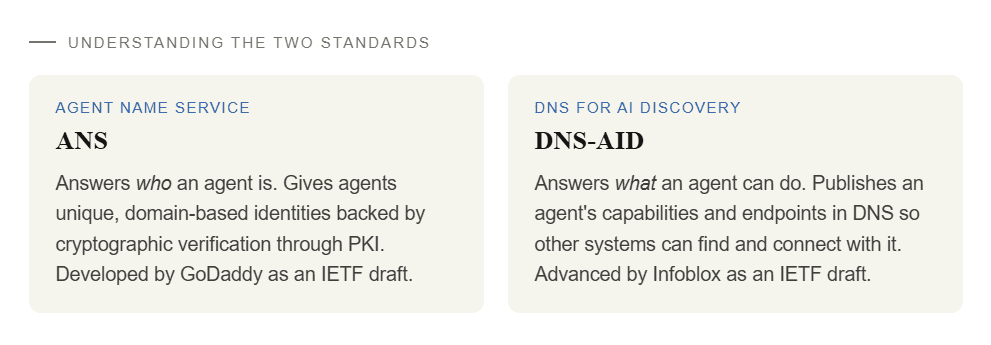
Infoblox, a company that has spent decades managing DNS for enterprise networks, and GoDaddy, the domain registrar that controls roughly 80 million domain names, announced this week that they are jointly backing two complementary open standards designed to give AI agents a verifiable identity and make them discoverable across the open web. The initiatives, called DNS-AID and Agent Name Service (ANS), are both built on DNS rather than any proprietary database or centralized platform. The argument is elegant, and the timing is deliberate.
AI agents are not a distant concept anymore. Software systems that can browse the web, book appointments, query databases, and take actions on behalf of users are already being deployed by companies of every size. But as these agents multiply, a fundamental problem is coming into focus: how does any website, application, or other agent know who it is actually talking to? Without a shared identity layer, the agentic internet risks becoming an ecosystem of anonymous, unverifiable actors, something that creates obvious problems for security, trust, and accountability.
The approach both companies are advocating is less a technical invention than a philosophical stance. Rather than building a new registry or a proprietary naming system, they want agent operators to use domain names they already own, and publish agent metadata using existing DNS record types that have been in use for years. The identity verification layer would rely on public key infrastructure, the same cryptographic system that secures HTTPS connections. In other words, the solution being proposed involves almost no new infrastructure at all.
"The lesson we learned from the 1970s-1980s is simple: no single entity could or should run the phonebook of the internet for everyone. DNS replaced it, not with another centralized list, but with an open, federated protocol that anyone could participate in. Forty years later, DNS remains the gold standard for digital trust and a scalable foundation where agents, Model Context Protocols, services and endpoints can be discovered and trusted through the same architecture that already powers the global economy." - Wei Chen, CLO and EVP, Regulatory Strategy, Infoblox
The historical analogy Chen is reaching for matters. Before DNS, the internet used a single text file, HOSTS.TXT, maintained by the Stanford Research Institute, to map names to addresses. Every computer on the network downloaded a fresh copy periodically.
As the network grew, the system collapsed under its own weight. DNS replaced it not by making one bigger central directory but by distributing the directory across thousands of authoritative servers, each responsible for its own corner of the namespace. The result was a system that has scaled from a few hundred hosts to hundreds of millions of domains without a central point of failure or control.
That decentralization is exactly what Infoblox and GoDaddy say the AI agent ecosystem needs to inherit. The concern, stated plainly in their joint announcement, is that if agent discovery and identity are left to platform vendors, those vendors will build proprietary registries. Companies deploying agents would then depend on whoever controls the registry to make their agents findable and trustworthy. That creates leverage, and the history of the internet suggests that leverage tends to be used.
GoDaddy's framing of the problem centers on verification. Jared Sine, the company's chief strategy and legal officer, has put it directly: "Agents will only reach their full potential on the open web if people and systems can verify who they are interacting with. Adopters of the Agent Name Service open standard leverages the only infrastructure that exists today that operates at the scale and speed of the global internet, DNS. We support Infoblox's work on DNS-AID and believe open standards for identity, discovery and verification will be critical as agents become part of everyday digital experiences."
The technical architecture they are proposing is worth understanding in some detail, because it is less exotic than it might sound. DNS-AID, the discovery standard being advanced by Infoblox, uses existing DNS record types, including SVCB records (Service Bindings, defined in RFC 9460), DNS-SD for service discovery, DNSSEC for cryptographic verification, and DANE for certificate binding. These are not new inventions. SVCB records were finalized in 2022 and are already used to carry metadata about web services. DNS-AID would extend that pattern to let AI agents publish information about their capabilities and endpoints in a standard, queryable format.
ANS, the identity standard GoDaddy is co-authoring, layers on top of that with a naming and verification scheme. An agent would have a domain-based name, something that maps to a domain the operator already controls, and would carry cryptographic proof of its identity through PKI certificates. The result is that any system interacting with the agent could, in principle, verify both who the agent claims to be and whether that claim is backed by a valid certificate chain rooted in infrastructure the operator controls.
Neither Infoblox nor GoDaddy is an AI company in the conventional sense. Infoblox sells DNS management, DHCP, and IP address management software to enterprises. GoDaddy is best known as the place people buy domain names, though it has grown into a significant provider of web hosting and small business tools. What both companies share is a deep commercial stake in the health of the DNS ecosystem, and a corresponding interest in seeing that AI does not route around it.
That interest is not cynical. DNS has a genuine track record as a neutral, federated coordination layer, and the companies are submitting their drafts to the Internet Engineering Task Force, the standards body that has overseen the development of most foundational internet protocols. The IETF process is slow and public, and it requires rough consensus among a broad community of implementers. Proposals that get through it tend to become real standards rather than abandoned white papers.
The announcement is also explicitly an invitation. Both companies say they want cloud providers, agent platform vendors, registrars, security companies, and standards organizations to join the work. The framing is pointed: the future of the agentic internet should not be decided by any single vendor or small group of companies, including, implicitly, Infoblox and GoDaddy themselves. Whether that commitment holds as the standards develop will be worth watching. But for now, the architecture they are proposing has one significant thing going for it: nobody owns DNS, and that is precisely the point.
The internet's history is largely a story of coordination problems solved by open protocols. Email works across providers because of SMTP. Web pages load everywhere because of HTTP. Domain names resolve consistently because of DNS. Each of those protocols was once a draft proposal that required industry adoption to become real. The question now is whether the AI agent ecosystem is ready to make the same kind of bet on openness that the early internet did, or whether the economic incentives of the current moment will push it toward fragmentation and control. The answer will shape how the next decade of software works.
Why the UAE Decided to Stop Buying Its Cybersecurity and Start Making It
Related Articles