

Big Tech
Oct 13, 2026
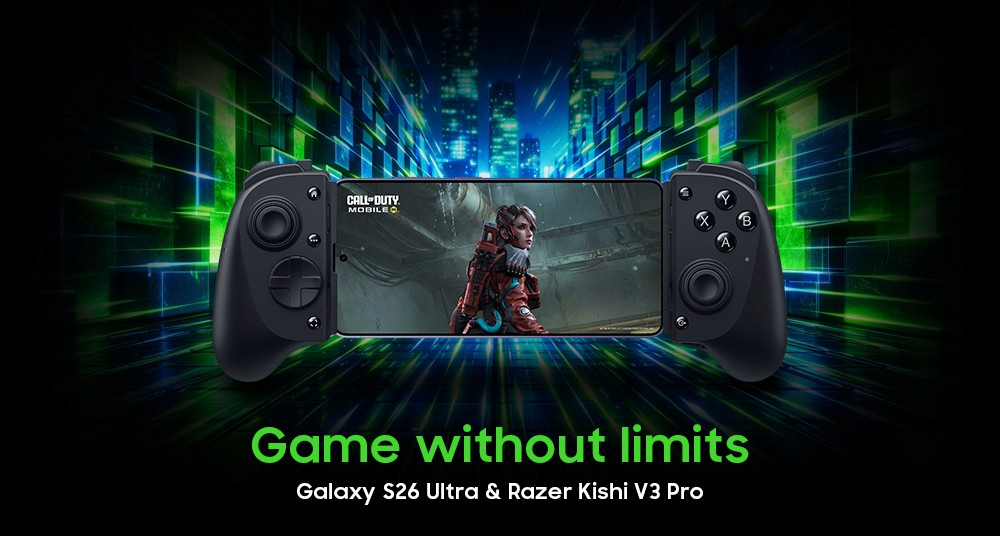
The Galaxy S26 Ultra and Razer Kishi V3 Pro partnership is less a marketing campaign and more a structural bet on where competitive gaming is going next.
[For more news, click here]
Mobile gaming in the Middle East and North Africa is no longer a casual side hobby. It is the primary gaming platform for a generation of players who expect the same performance benchmarks from a smartphone that their counterparts in PC or console gaming take for granted. Samsung Electronics MENA has spent the better part of the last three years building toward that expectation. Its new "Game Without Limits" campaign, developed in collaboration with Razer, puts that ambition on the table in the most direct terms yet.
The campaign is built around two pieces of hardware: the Galaxy S26 Ultra and the Razer Kishi V3 Pro controller. But the more interesting story is not the hardware itself. It is the strategic logic that brought these two companies together, and what that collaboration signals about where premium mobile gaming is actually headed.
Samsung and Razer do not obviously overlap. One is a consumer electronics giant with dominant market share across smartphones, displays, and home appliances. The other is a specialist brand that has spent two decades earning credibility among the most demanding segment of the gaming market. That credibility is not transferable by association alone. Razer's audience knows the difference between authentic gaming hardware and lifestyle branding, and they are not forgiving of the latter.
For Samsung, that specificity is exactly the point. Putting the Galaxy S26 Ultra alongside a Razer product is a deliberate signal to a skeptical audience: this phone is built for the way you actually play, not the way a marketing deck imagines you play. For Razer, the collaboration extends the Kishi V3 Pro into a market segment it could not reach as effectively on its own, pairing it with a flagship Android device that has the hardware headroom to justify the controller's capabilities.
The result is a product pairing that earns its positioning rather than asserting it.
The Galaxy S26 Ultra's gaming credentials start with the Qualcomm Snapdragon 8 Elite Gen 5 for Galaxy chipset, a processor built for sustained high-performance workloads rather than peak benchmark numbers that drop off under thermal pressure. This distinction matters considerably in mobile gaming, where the worst-case scenario is not a low frame rate at launch but performance degradation fifteen minutes into a session when the device heats up.
Samsung's response to that problem is an advanced vapor chamber cooling system integrated directly into the S26 Ultra's thermal architecture. The system is designed to sustain the kind of output required for ray-tracing capable gameplay, a feature set that was, until recently, firmly in the territory of dedicated gaming hardware. The S26 Ultra makes it available in a device that fits in a pocket.
The phone also introduces what Samsung describes as the world's first "Privacy Display" in a smartphone. In the context of a gaming device used in public environments, the feature has obvious utility. It allows players to manage on-screen content visibility without switching applications or altering their setup.
The Razer Kishi V3 Pro brings a full-sized controller experience to mobile without the compromises that typically define the category. Its full-size TMR thumbsticks, which use tunnel magnetoresistance technology for more accurate input tracking than traditional analog sticks, come with swappable caps that allow players to customize the feel to match their preferences and play style.
The controller supports both wired and remote play for PC, which means it functions as a bridge between mobile sessions and home gaming setups rather than as a device that exists only in one context. For players who move between environments throughout the day, that flexibility removes a friction point that dedicated mobile controllers have historically carried.
The ergonomic design is worth noting separately. Mobile gaming sessions that extend beyond thirty minutes put real physical demands on players, and controllers that do not account for grip fatigue become a limiting factor in competitive play. Razer's approach here reflects the same attention to physical design that defines its PC peripheral line.
The "Game Without Limits" campaign is not operating in a vacuum. Mobile gaming across the MENA region has grown substantially over the past five years, driven by smartphone penetration rates that outpace much of the world, a young demographic profile, and the rise of competitive titles that have built large regional player bases. Titles like PUBG Mobile, Call of Duty Mobile, and Mobile Legends are not casual diversions for this audience. They are the primary competitive arena.
That context sharpens the significance of a campaign built around the word "competitive." Samsung and Razer are not selling mobile gaming as a convenient alternative to console or PC play. They are positioning it as a legitimate primary platform, with hardware that can hold its own against dedicated gaming setups in the metrics that serious players actually measure: input latency, sustained frame rates, thermal stability, and control precision.
Omar Saheb, Regional Vice President of Marketing and Online Business at Samsung Electronics MENA, framed it in terms of expectation: "Gaming has become a core experience for today's youth, and they expect their devices to keep up with the speed, performance, and immersion of modern gameplay. With the Galaxy S26 Ultra and the Razer Kishi V3 Pro, we're bringing together powerful mobile performance and precision control to deliver a more immersive and competitive gaming experience."
Ignacio Sune, Sales and Marketing Vice President of Razer EMEA, articulated the design philosophy that makes the partnership coherent: "Razer's philosophy is to build products that help gamers play with greater control and confidence. Working with Samsung enabled us to bring that same approach to mobile, allowing gamers to enjoy the full potential of mobile gaming without compromising control."
The Samsung and Razer collaboration points to something larger than a product launch. It reflects a genuine convergence between the smartphone industry and the gaming hardware industry, two sectors that have historically operated in parallel rather than together. As mobile processors close the gap with dedicated gaming silicon, and as the gaming audience matures into a segment that demands precision hardware, that separation becomes less defensible.
For players across the MENA region, what "Game Without Limits" ultimately delivers is a viable answer to a question that serious mobile gamers have been asking for years: whether a smartphone setup can genuinely compete with dedicated gaming hardware on the terms that matter most. The Galaxy S26 Ultra and Kishi V3 Pro, positioned together, represent the most credible industry answer to that question so far.
Related Stories from TechRevolt
How the 2026 FIFA World Cup Became the Most Revealing Test of AI in the Workplace
How Bolt Turned a People Problem Into a People Ops Playbook
Exclusive: Policy, Diplomacy and the Quiet Work of Making Europe Competitive Again
Related Articles


