

Big Tech
Sep 16, 2026
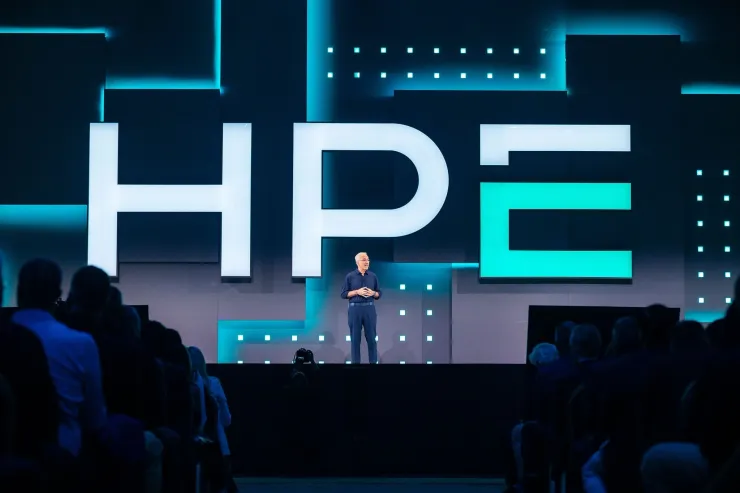
Every year, the technology industry produces a fresh crop of AI announcements engineered to sound revolutionary. Most of them aren't.
[For more news, click here]
The genuinely consequential shift happening in enterprise technology right now is quieter than that, and it showed up clearly last week at HPE Discover Las Vegas 2026, where Hewlett Packard Enterprise spent four days arguing that the hardest problem in AI isn't building smarter models. It's building infrastructure disciplined enough to let those models run unsupervised inside a real company without something breaking.
For the past two years, the American AI conversation has mostly been about capability, what the model can do, how fast it can reason. HPE used its flagship event to make a different argument, aimed less at AI researchers and more at the CIOs and network architects who have to make agentic AI work inside a functioning enterprise without it becoming a liability. The company's pitch, delivered across three coordinated announcements with NVIDIA, is that the technology has outrun the operational scaffolding meant to support it, and that closing that gap is now the more urgent problem.
The starting point for HPE's announcements is a blunt admission about where enterprise AI stands. Companies have spent years experimenting with AI agents in pilots and sandboxes. Far fewer have moved them into production, where an autonomous system might approve transactions or make decisions that used to require a human signature. The reason is not a shortage of ambition. It is a shortage of trustworthy plumbing.
"As AI becomes more autonomous, organizations need a new architecture to run it securely, govern it responsibly, and scale it economically," said Antonio Neri, president and CEO of HPE. "Across networking, servers, storage and software, HPE is delivering full-stack AI solutions with NVIDIA that build the foundation for agentic enterprises, helping customers move from experimentation to production with control and confidence."
Jensen Huang, founder and CEO of NVIDIA, framed the moment in sweeping terms, describing a rebuild of the computing stack rather than an incremental upgrade. The companies' joint answer expands the HPE AI Factory with NVIDIA, folding in NVIDIA's new Vera CPU, an Agent Toolkit for managing AI behavior in production, and confidential computing features that protect sensitive model and data activity while agents work with it. HPE's ProLiant Compute DL394 Gen12 server, built around the Vera CPU, gives the partnership dedicated hardware for high-throughput agentic workloads.
The more interesting part is what those upgrades solve for. A unified model gateway now governs which frontier models an organization's agents may call, rather than leaving that decision scattered across teams. Multi-node inferencing support, scaling to 256 GPUs, addresses the unglamorous problem of token costs ballooning as agent usage grows. None of this makes headlines. It determines whether a company's AI ambitions survive contact with its own budget and compliance department.
If compute and governance were the first leg of HPE's argument, networking was the second, and the one with the deepest roots in the company's recent history. A year after closing its acquisition of Juniper Networks, HPE used Discover to show what that deal was for: merging two networking philosophies into a single, AI-managed nervous system spanning the edge, the campus, the data center, and the AI factory itself.
The headline move is the alignment of HPE Aruba Central and HPE Mist AI, the company's two flagship network operations platforms, previously built on largely separate logic. The two are now knitted together through shared agentic capabilities, common hardware, and consistent AI-native operations, what HPE calls its cross-pollination strategy. HPE Networking CX switches, long managed through Aruba Central, can now run on the Mist platform and inherit more advanced automation, including AI-native traffic visibility, zero-touch provisioning, and a self-driving framework called Marvis that diagnoses and fixes problems before a human notices them.
Marvis is the part most likely to change daily life for an overworked network administrator. New automated remediation features handle wired-port troubleshooting and corrective action directly, work that used to eat entire afternoons. On the data center side, HPE introduced new Juniper Networking QFX switches tuned for AI inferencing and scale-up workloads, deepening integration with HPE's broader AI Data Center Solution. A new AI-native SASE platform, combining software-defined networking with zero trust security in one console, treats network security and performance as a single continuous problem.
The logic is straightforward. As AI workloads spread across more locations and autonomous decision points, the network stops being background plumbing and becomes the layer actually watching, and increasingly managing, everything else.
The third piece of HPE's announcement slate addressed a problem familiar to anyone who has run enterprise IT for more than five years, the slow accumulation of tools that don't quite talk to each other. HPE used GreenLake, its cloud delivery platform, and HPE Morpheus Software, its virtualization and orchestration layer, to argue that AI operations need a single control plane rather than another specialized tool bolted onto an already crowded stack.
"As enterprises scale AI, they need a simpler way to govern AI infrastructure and modernize operations across hybrid environments without fragmentation or unpredictable costs," said Fidelma Russo, EVP, President and GM of Hybrid Cloud and CTO at HPE. "The latest advancements in GreenLake give enterprises a proven, unified path for agentic hybrid operations today and a foundation for future autonomous operations."
GreenLake Intelligence now includes a centralized registry that tracks every AI agent an organization has deployed, along with planning, orchestration, and governance tools that keep that population of agents from operating as an ungoverned swarm.
The HPE OpsRamp Operations Copilot gives IT teams visibility into what those agents and the large language models behind them actually cost, tracking token consumption and correlating performance issues across multi-vendor infrastructure. A new partnership with ServiceNow extends that visibility further, feeding observability data directly into automated service delivery so an infrastructure problem can move from detection to resolution without a human relay race in between.
HPE Morpheus Software picked up its own Orchestration Copilot, removing the manual, error-prone work of provisioning infrastructure by hand. A new Morpheus Central console centralizes management across deployments, and a deepened collaboration with Citrix will eventually bring desktop-as-a-service onto GreenLake, aimed at regulated industries that want cloud flexibility without losing control of where their data lives.
Put the three announcements together and a clear pattern emerges. HPE is not trying to win the AI conversation with a flashier model or a louder demo. It is trying to win it by making the unglamorous parts of AI deployment, governance, cost control, network reliability, observability, sturdy enough that American enterprises can trust agentic AI with real responsibility instead of confining it to a pilot program indefinitely.
That is a useful corrective to an AI narrative that has spent two years obsessing over model capability while underweighting the operational discipline needed to deploy it safely. The companies that give their AI systems clean governance, transparent costs, and a self-healing network underneath them are the ones likely to move past the pilot phase first, while everyone else spends another budget cycle discovering how much friction was hiding in their own infrastructure. HPE's bet at Discover this year was that getting that foundation right is, paradoxically, the most exciting work happening in enterprise AI today.
Why AI Is Creating a Data Crisis Inside the Enterprise
Everpure Launches a Fix for AI's Data Problem
Why Pinterest Chose Purpose-Built Silicon Over General AI Infrastructure
Related Articles