

Crypto
Sep 17, 2026
Crypto
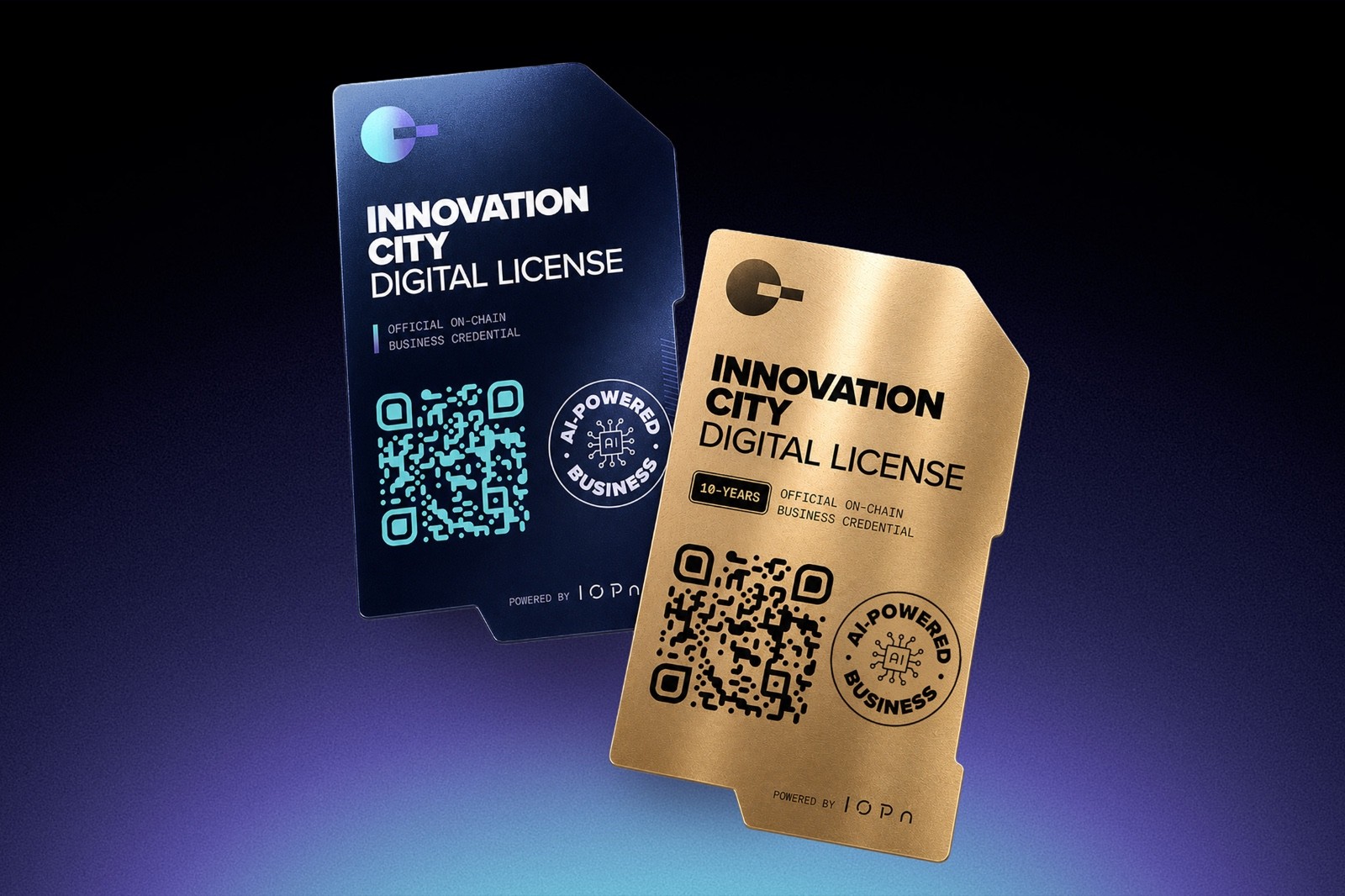
For most of modern business history, a company's legal existence has lived inside a filing cabinet, a government database, or, at best, a PDF stamped with an official seal. That identity is static. It does not travel well. It cannot talk to a machine. It gets faxed, apostilled, notarized, re-notarized, and still takes weeks to verify across borders. The whole system is, in a very real sense, administrative theater built for a world that ran on paper.
[For more news, click here]
On May 4th, 2026, a free zone in the United Arab Emirates announced it was done with all of that.
Innovation City, the AI-focused free zone operating in Ras Al Khaimah, launched what it is calling the world's first blockchain-based digital business identity system. Every company registered within its jurisdiction now receives a cryptographically verifiable, on-chain identity powered by OPN Chain, a high-performance Layer 1 blockchain developed by the infrastructure company IOPn. The business license is no longer a document. It is a living digital asset, permanently recorded, publicly auditable, and readable by machines in real time.
This is not a pilot program. It is not a blockchain press release dressed up as policy. It is a structural shift in how a regulatory authority defines corporate existence, and it is happening at a moment when the stakes of getting this right have never been higher.
The concept sounds technical, and it is, but the practical implications are straightforward. When a company registers with Innovation City, it now receives what the system calls a "soulbound" digital asset: an identity token that cannot be transferred, sold, or separated from the business entity it represents. Every subsequent event in that company's life, an ownership change, a compliance update, a license renewal, gets written to the blockchain as a permanent, immutable record.
What this means for verification is significant. Today, confirming that a company is legitimate, properly licensed, and in good standing typically involves contacting a government registry, waiting for a response, sometimes hiring a local law firm, and accepting that the information you receive is only as current as the last time someone updated a database. The process is slow, expensive, and riddled with opportunities for fraud.
With an on-chain identity, a bank, a regulator, an investor, or an AI agent can query the blockchain directly and receive a verified answer in seconds. No intermediary. No waiting. No uncertainty about whether the document in front of you is real.
"Today we don't just register companies, we give them a soul on the blockchain," said Paul Dawalibi, CEO of Innovation City. "For decades business identity has been trapped in paper, PDFs, and fragile databases, slow, opaque, and built for a world that no longer exists. We are ending that era. Every enterprise in Innovation City now carries a living, verifiable digital identity that travels with it across borders, platforms, and straight into the age of intelligent agents. Ras Al Khaimah isn't following the future. We are writing it. One more thing: the companies that claim their place on this chain today will lead the global economy tomorrow. Everyone else will be explaining why they're still using yesterday's tools."
Here is the part of this story that deserves more attention than it is getting.
The UAE government recently announced a sweeping directive to transition 50 percent of federal government services, sectors, and operations to Agentic AI within two years. Agentic AI refers to autonomous AI systems capable of taking actions, making decisions, and completing complex workflows without constant human oversight. Think of it as AI that does not just answer questions but actually does things: filing forms, processing approvals, executing transactions, flagging compliance issues.
For agentic systems to function at government scale, they need one thing above all else: trustworthy, machine-readable data about the entities they are interacting with. An autonomous AI agent processing a business license application cannot call a government office and ask if a company is legitimate. It needs to be able to verify that fact programmatically, instantly, and with certainty.
That is precisely what on-chain business identity provides. Without it, autonomous government systems are essentially flying blind every time they interact with a corporate entity. With it, they have a real-time, cryptographically secured source of truth they can query without human intervention.
This is why the timing of Innovation City's announcement matters. The infrastructure is not being built after the AI systems arrive. It is being built before them, which is exactly the right order of operations.
Mojtaba Asadian, CEO of IOPn, framed it in terms of sovereignty: "IOPn is the sovereign infrastructure layer enabling the UAE's agentic AI economy, starting with business identity and built to scale across jurisdictions, institutions, and sectors. Cryptographically secure. Evolving. Interoperable. Compliant. When Innovation City chose OPN Chain to power the world's first on-chain business identities, they didn't just pick a technology, they chose the infrastructure of digital sovereignty. Together, we are proving that the future of enterprise is not centralized databases or fragmented systems. It is sovereign, verifiable, and alive on-chain."
Beyond the AI angle, there is a more immediate, less futuristic case for on-chain business identity: it makes fraud substantially harder.
The global economy loses hundreds of billions of dollars annually to corporate fraud, including shell company schemes, falsified ownership structures, and document counterfeiting. Much of this fraud succeeds because business identity systems are opaque. Beneficial ownership information is buried in registries that are difficult to access, rarely updated, and almost never cross-referenced in real time.
A blockchain-based system changes that calculus. Because every change to a company's record must be written to the chain and is permanently visible, the ability to quietly restructure ownership, swap out directors, or present outdated compliance documentation becomes dramatically more constrained. Fraud is not eliminated, but the audit trail is continuous, immutable, and public in a way that no centralized database can match.
For financial institutions, this is significant. Know-Your-Customer and Anti-Money-Laundering compliance processes that currently take days and cost substantial resources could, in theory, be reduced to an automated query against a verified on-chain record.
It would be a mistake to read this purely as a technology story. It is also a story about which jurisdictions are positioning themselves to define the rules of the emerging digital economy.
The UAE has been deliberate and aggressive in building regulatory infrastructure for technologies that most governments are still debating. The country has established clear frameworks for cryptocurrency, AI governance, and digital assets at a speed that Western regulatory bodies have found difficult to match. Innovation City's blockchain identity system fits squarely within that pattern.
By creating the world's first jurisdiction where on-chain business identity is the standard, not an option, Ras Al Khaimah is effectively writing a template. If the system works, if it reduces fraud, speeds up verification, and proves compatible with agentic AI systems, other jurisdictions will face pressure to adopt similar frameworks or risk falling behind in the race for foreign investment and digital commerce.
The technical specifications of OPN Chain, a high-performance blockchain capable of more than 10,000 transactions per second with sub-second finality and compatibility with the Ethereum Virtual Machine, suggest that the system was designed with scalability and interoperability in mind from the start. It is not a closed garden built for one free zone. It is infrastructure designed to connect with the broader global financial and regulatory ecosystem.
Innovation City is, for now, one free zone in one emirate. The companies registering there represent a fraction of global commerce. But the significance of what was announced this week is less about the current scale and more about what it proves is possible.
The idea that a government-issued business identity could be a dynamic, machine-readable, cryptographically secure digital asset rather than a static document in a database has been discussed in policy circles for years. What has been missing is a jurisdiction willing to commit to building it and deploying it as the operational standard for every company it registers.
That jurisdiction now exists.
For businesses evaluating where to incorporate as AI-native operations become the norm rather than the exception, the calculus just shifted. For regulators watching from Brussels, Washington, Singapore, and London, the experiment in Ras Al Khaimah is now a live case study with real companies, real transactions, and real data.
The paperwork era of business identity is not going to end overnight. But it just got a credible, operational alternative. And the entity that built it did not wait for a global consensus. It simply built the future and opened the doors.
Related Articles


