
Big Tech
Oct 7, 2026
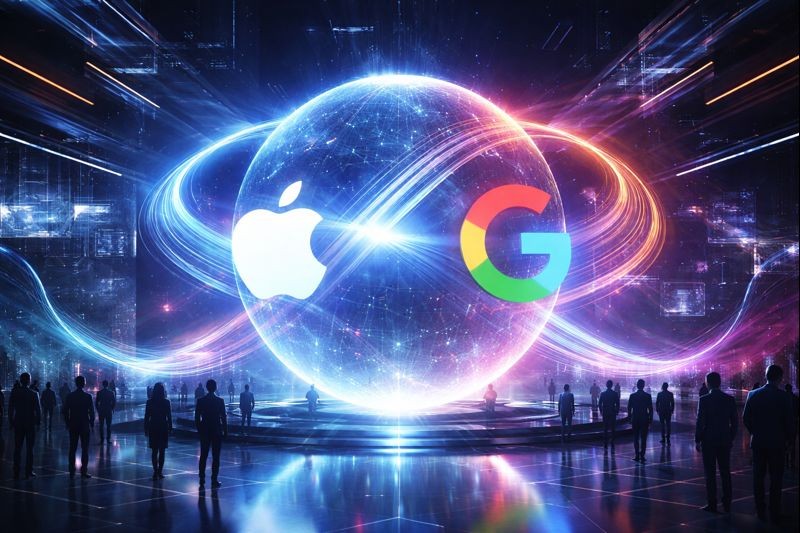
For more than a decade, Apple and Google have embodied two competing visions of the digital world. One built on tightly controlled hardware, ecosystems and privacy-led differentiation. The other driven by data, scale and cloud-native intelligence. That is why Apple’s confirmation that the next generation of Apple Foundation Models will be based on Google’s Gemini models and cloud technology marks one of the most consequential shifts in the modern technology landscape.
According to Apple’s official statement, the multi-year collaboration will see Google’s AI models underpin future Apple Intelligence features, including a more personalised version of Siri launching this year. While Apple Intelligence will continue to run on-device and via Private Cloud Compute, Apple has concluded that Google’s AI technology provides the most capable foundation for its next phase of generative intelligence.
This is not just a partnership. It is a signal that the rules of competition in AI are being rewritten.
The generative AI race has moved beyond novelty. The industry is now in its infrastructure phase, where model quality, compute efficiency, latency and real-world deployment matter more than flashy demos. Apple, despite its dominance in hardware and consumer platforms, entered this phase at a relative disadvantage.
As reported by multiple industry analysts, Apple’s internal models have lagged behind peers in large-scale reasoning, multimodal performance and rapid iteration. While Apple has unparalleled silicon, device integration and distribution, training frontier models at global scale requires immense cloud infrastructure, data pipelines and model refinement cycles.
Google, by contrast, has spent years building exactly that. Gemini represents the culmination of Google’s vertically integrated AI stack, combining custom chips, cloud infrastructure and models trained across text, image, video and code. According to Apple, after careful evaluation, Google’s AI technology offered the strongest foundation to build upon, without compromising Apple’s privacy-first principles.
This is a pragmatic decision, not a philosophical surrender.
What makes this deal truly significant is what it says about the future structure of the technology industry. AI is rapidly becoming a shared foundational layer, much like semiconductors, networking standards or operating systems before it.
Apple’s choice suggests that even the most powerful consumer technology company in the world no longer sees full-stack AI independence as necessary or efficient. Instead, differentiation will increasingly happen at the experience layer, not the model layer.
Apple Intelligence will still feel “Apple.” Siri will still live inside Apple’s ecosystem. Privacy will still be enforced through on-device processing and Private Cloud Compute. But beneath the surface, intelligence itself is becoming modular.
This mirrors what happened with search, mapping and even mobile processors, where partnerships quietly replaced ideological purity. The era of every tech giant building everything in-house is giving way to strategic interdependence.
Privacy has long been Apple’s sharpest competitive weapon against Google. Understandably, this partnership raises questions about whether that line has blurred.
Apple is attempting to draw a clear boundary. According to its statement, Apple Intelligence will continue to run on devices and within Apple’s Private Cloud Compute environment, maintaining what it describes as industry-leading privacy standards. Google’s role, at least publicly, is to provide the underlying model architecture and cloud technology, not access to user data.
If executed as promised, this could redefine what privacy-preserving AI looks like at scale. Rather than training and inference being synonymous with data extraction, Apple is betting that advanced models can be deployed without compromising user trust.
However, the success of this approach will depend not on statements, but on implementation. Regulators, developers and users will scrutinise where data flows, how models are updated, and who ultimately controls optimisation decisions.
This deal sends an unmistakable message to the rest of the industry. AI leadership is no longer just about who has the best standalone model, but who can embed intelligence most seamlessly into daily life.
For Microsoft, which has tied its AI future closely to OpenAI, the Apple–Google partnership reinforces the importance of deep platform integration. For Amazon, it highlights the value of offering AI as infrastructure rather than just consumer-facing products. For smaller players, it raises the barrier to entry even further.
According to market observers, we are entering a phase where only a handful of AI infrastructure providers will exist globally, while most companies will build differentiated experiences on top of them. This concentrates power, but it also accelerates adoption.
For developers, this could mean more capable tools, but fewer truly independent platforms. For consumers, it likely means smarter assistants, better contextual understanding and less friction across devices.
Perhaps the most immediate and visible impact will be on Siri, a product that has long struggled to keep pace with rivals. Despite being one of the earliest voice assistants, Siri fell behind in conversational intelligence, contextual awareness and adaptability.
By leveraging Gemini-based foundation models, Apple is effectively rebooting Siri’s cognitive engine. According to Apple, this will enable more personalised, context-aware interactions, bringing Siri closer to the vision originally promised over a decade ago.
If successful, this could reshape how users interact with their devices, moving from command-based interactions to ongoing, intelligent dialogue. That shift has implications not just for usability, but for commerce, productivity and accessibility.
At a broader level, this collaboration reflects a maturing industry. Competition has not disappeared, but it has become more layered. Apple and Google will still compete fiercely in smartphones, operating systems, services and ecosystems. Yet they are willing to collaborate where it accelerates progress and reduces duplication.
According to industry insiders, this is likely not the last such partnership we will see. As AI becomes more capital-intensive and strategically critical, even rivals will seek alignment where incentives overlap.
This also complicates the regulatory narrative. Governments have traditionally viewed Big Tech through the lens of rivalry and dominance. Cross-company AI collaboration introduces new questions about concentration, dependency and systemic risk.
Apple’s decision to build on Google’s Gemini models does not diminish Apple’s identity. Instead, it reinforces a reality many in the industry have been reluctant to admit: the future belongs to those who know where to differentiate, and where to collaborate.
The real battle is no longer about who builds the biggest model, but who earns the most trust, delivers the most value and integrates intelligence in ways that feel human, not invasive.
If Apple and Google get this right, users may barely notice the shift. And that, paradoxically, is the point.
Related Articles