

MENA News
Sep 10, 2026
MENA News
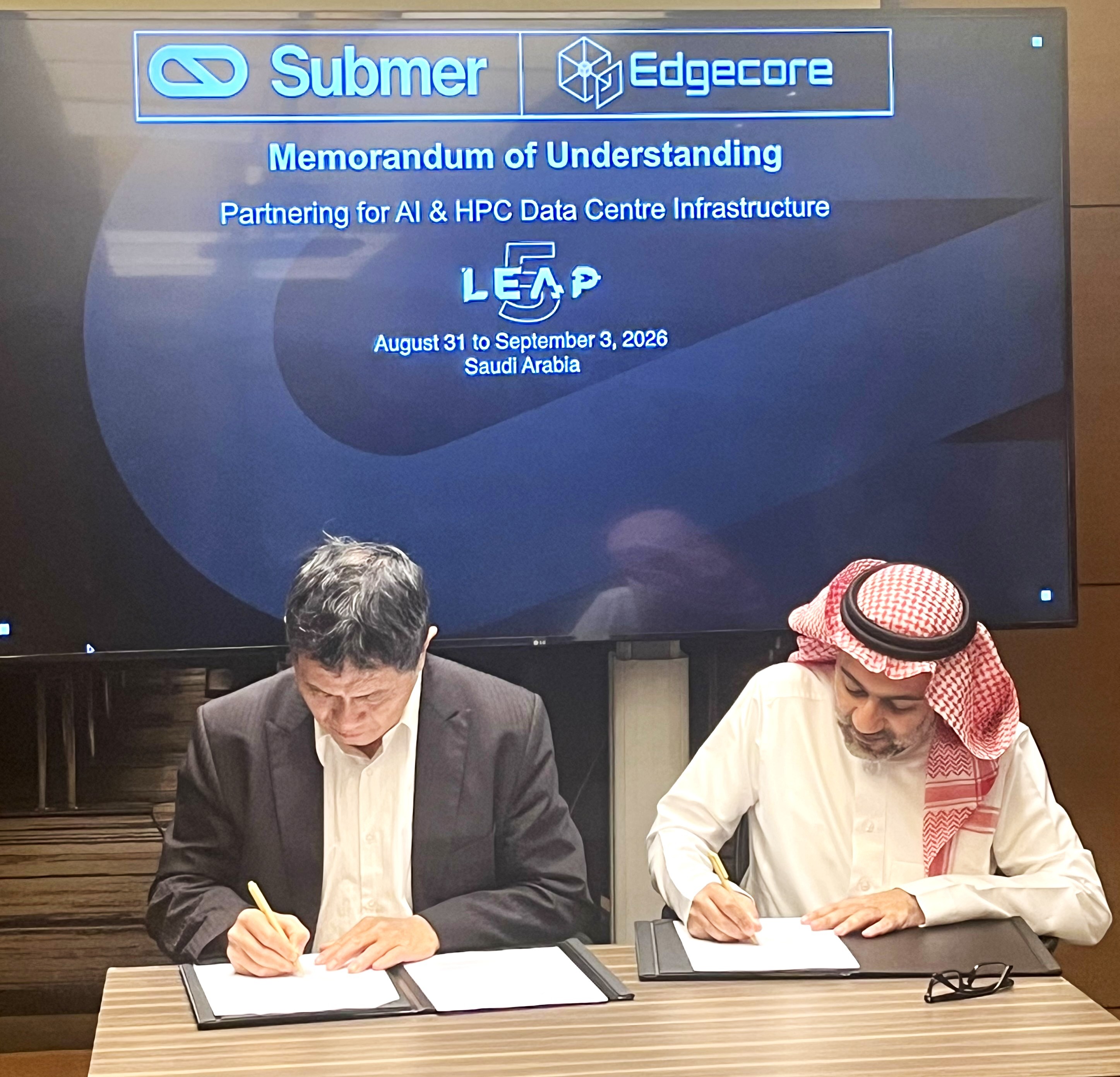
Submer and Edgecore Networks have signed a Memorandum of Understanding to jointly design AI-ready data centers across the Middle East, Turkey, and Africa, pairing Submer’s power and advanced cooling work with Edgecore’s open networking.
[For more news, click here]
A single rack of AI accelerators in a modern data hall can draw more than 100 kilowatts of power and reject heat that ordinary air conditioning cannot move. In the Gulf, where there is already extreme heat and scarce water, cooling becomes an engineering question anyone building the facility has to look into first.
In an agreement announced on September 14 in Dubai, Submer, a Spanish full-stack AI and high-performance computing infrastructure company, and Edgecore Networks, a Taiwan-based open networking vendor, signed a Memorandum of Understanding to jointly pursue AI-ready data center projects across the Middle East, Turkey, and Africa. The MoU, although just in the singing phase, signals a growing recognition that the way the industry has assembled data centers for so long no longer fits the machines going into them.
For most of the cloud era, a data center came together in layers with one firm designing the building and its power, and another handling the cooling. A third supplied the servers, and a fourth wired the network. Each layer could be specified more or less on its own, because a rack drawing 5 to 10 kilowatts left comfortable margins for error. GPU clusters have erased those margins and now, when a row of accelerators pulls the power of a small neighborhood and the network fabric linking them decides whether costly chips sit idle waiting for data, power, cooling, networking, the floor layout stops being separate decisions and become one interdependent problem.
“The AI infrastructure market is entering a new phase. Customers are no longer simply looking for individual technologies; they need infrastructure that is engineered to work together from the outset,” said Khalid Aljamed, General Manager, Middle East, Turkey and Africa at Submer. “As GPU densities increase, power, thermal management, networking and facility design become fundamentally interconnected. Our collaboration with Edgecore brings together complementary expertise to help customers approach these requirements as one coordinated infrastructure environment, supporting faster and more efficient deployment of AI capacity across the region.”
The two companies, sitting at opposite poles of the problem, unite to find an optimal solution. Submer covers advisory work, design and build, power, thermal management, and IT integration, and is known for liquid and immersion cooling that pulls heat directly off dense hardware instead of relying on chilled air. Edgecore builds open, high-bandwidth switching, spanning AI and machine learning fabrics, data center and optical networking, and disaggregated hardware that runs a customer’s choice of software rather than a single vendor’s locked stack. Under the MoU the pair plan to develop joint reference designs, align networking with power and cooling earlier in planning, and take combined offers to enterprises, operators, and government-backed AI programs across the region.
“AI workloads are reshaping the requirements for data center networking, particularly as GPU clusters scale in size and performance,” said Mingshou Liu, CEO of Edgecore Networks. “Edgecore’s open networking approach provides the flexibility and performance needed for these environments. By combining our networking capabilities with Submer’s expertise in advanced thermal and data center infrastructure, we can help customers address the broader infrastructure requirements of high-density AI deployments in a more integrated way.”
In the Middle East, data center construction spending is on course to pass $11 billion by 2031, growing at roughly 26 percent a year, according to research firm Arizton, with liquid cooling’s share of that investment rising from about 41 percent in 2025 toward 54 percent by 2031. Saudi Arabia’s $100 billion HUMAIN program and the UAE’s drive to host frontier compute have turned sovereign AI from a slogan into procurement, generating demand for GPU halls rated well above 100 kilowatts per rack.
Nvidia supplies the accelerators, and Microsoft, Amazon, Google, and Oracle are all expanding Gulf capacity, including a Microsoft and G42 data center expansion tied to more than $15 billion of investment in the UAE. For United States technology firms and investors, the region has become one of the largest new markets for AI infrastructure outside North America, which makes how that capacity gets built a commercial question as much as a regional one.
Desert heat pushes engineering tensions towards cooling toward liquid and immersion systems, yet strict limits on industrial water use in Saudi Arabia and the UAE rule out the open-loop, water-hungry cooling that operators elsewhere lean on. Builders are steered toward closed-loop and immersion approaches, which is exactly the thermal territory Submer works in. Retrofitting a building for that kind of cooling is expensive, so decisions about heat, power, and network layout increasingly have to be made together, before concrete is poured.
While an MoU commits the two companies to explore work, not to deliver, the region’s AI ambitions still carry real risks. Among them a shortage of trained data center engineers and volatile power tariffs, tight water budgets, and the geopolitical exposure that comes with building critical infrastructure in a contested part of the world. Whether co-designed infrastructure proves cheaper or faster than the layered approach it aims to replace will only be clear once joint projects are running.
As AI models push rack densities and power draw past what the build-it-in-layers model was designed for, the pressure to engineer facility, power, cooling, and networking as a single system is growing across the industry, and nowhere faster than in the markets spending the most to catch up. The announcement follows Submer’s expansion across the region, including a Saudi Arabia headquarters established late last year. For Submer and Edgecore, the agreement rests on a straightforward idea, that in AI infrastructure the individual parts now count for less than the way they fit together.
Exclusive: Hyperscalers Signal Rising Confidence in AI Multi-year Growth Cycle
Exclusive: Yousef Barkawie on the Next Phase of AI in the Middle East
LEAP 2026 Ends With Saudi Arabia Turning to the People Behind Its AI Push
Related Articles


