
Technology
Oct 21, 2026
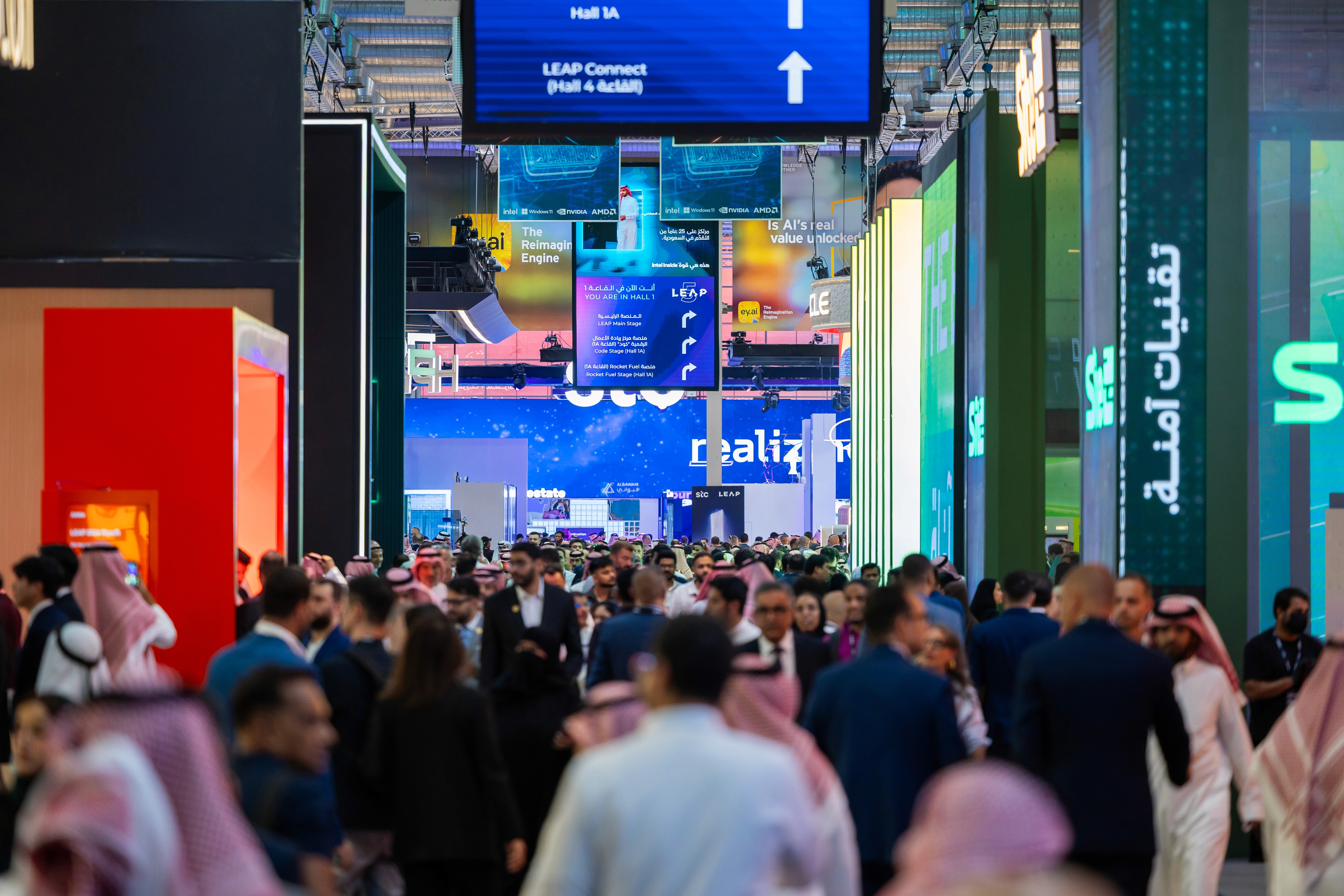
The final day of LEAP 2026 shifted the conversation from the technology itself to the people and systems needed to make Saudi Arabia’s AI ambitions work.
[For more news, click here]
Data centers matter, as do the cloud regions, chips, models and platforms being built around AI, but technology does not transform nations on its own. People do. That was the message from the main stage on September 3, the final day of LEAP 2026.
What followed was the largest block of skills commitments the event has produced, with nine launches under MCIT’s Future Skills initiative announced back to back in half an hour.
Nine commitments, thirty minutes
A full year of free Google AI Plus access, powered by Gemini, will go to one million university students, beginning in the Kingdom and expanding across Arab countries including Egypt and the UAE. The three-million-by-2030 training target was also reaffirmed with progress attached, 1.6 million reached, an AI Academy for the remaining 1.4 million, and an AI Center of Excellence convening government, academia and industry. ALIF, an eleven-component program over four years, will upskill 100,000 Saudis in hands-on AI.
Alongside those commitments came targets for 100,000 young talents by 2030 and 1.2 million beneficiaries through Saudi AI Forward, announced in absentia. A School of AI and Data will target 20,000-plus Saudi graduates by 2034, with a stated output that is not engineers but “AI business translators.” Another 20,000 national talents are being targeted across digital marketing, augmented reality and digital safety. An Energy Tech Academy opens in November aimed at 10,000 online trainees, while a Canadian academy launching in-Kingdom will reach 50,000 learners.
For all of those numbers, a more revealing moment came from the body measuring how ready government itself is to adopt AI. The National AI Index measures government readiness across seven pillars and 23 domains. Its first cycle produced unusually candid findings, most entities remain in the activation and building phase, data scored among the lowest, human capability also scored low, and infrastructure is the bottleneck, with very few entities holding the compute to scale. Strong data practice, the panel noted, does not by itself make an entity ready for AI.
Building the index also became a demonstration of the technology it was designed to measure. Indices are traditionally heavy with manual work and paperwork, so this one was built out of agents, 23 domain specialists with an orchestrator sitting on top.
“75% speed in how we managed the index and 90% certainty in the results, because we don’t only leverage AI but we freed up the team for judgment work and not just paperwork.” said Abdullah Alkhodairi, Chief Strategy Officer, SDAIA.
Across 30 to 35 government entities, deployment runs further ahead than the index scores suggest. An AI agent performs medical triage in primary care for 30 to 40% efficiency gains; vision AI validates citizens for ID, license and passport renewals, cutting physical visits by roughly 50%; image processing captures visual pollution across streets and cities, producing the equivalent of 9,000 employees’ workload.
One forward-looking proposal stood out, agents carrying a unique identifier inherited from a human, so accountability survives autonomy. At the fund level, the shift has also moved from siloed use cases toward decomposing entire workflows into units of work, tested centrally and then cascaded across 200-plus portfolio companies.
“We’re building not an AI stack, but an AI economy.” stated Suha Kayum, Director and Head of AI and Advanced Analytics, PIF
The same tension surfaced in a fireside later in the day, where Trevor Thompson, Global Managing Director at Scale AI, made the case against some of the hype surrounding his own industry.
“But the gap between that and real impact in enterprise and government and anything is almost widening as the frontier capabilities get better.” said Trevor Thompson, Global Managing Director, Scale AI
AI is oversold in strategy, on this account, and underused on the boring work, eight months on patient intake at Mayo Clinic bought eleven more minutes between doctor and patient. Data readiness is another recurring trap, with teams spending years cleaning data, then chasing their tail as the company generates more. Against prevailing anxiety, enterprises deploying AI are showing a net increase in hiring.
Care that reaches everyone
The most affecting session of the event came from an ophthalmologist who spent 35 years watching diabetic patients arrive already blind.
Saudi Arabia has 5.34 million diabetics, up roughly two million in three years. Every diabetic requires an annual exam and only about half receive one, because the Middle East has fewer than five ophthalmologists per 1,000 diabetics. The constraint is not the science, there are not enough specialists to do the screening.
SARIA was described as the first Saudi FDA-approved diagnostic for diabetic retinopathy, two photographs, a result in under a minute, over 90% sensitivity, hosted in the Kingdom and reporting in Arabic. The deployment numbers lead, 25 sites and 70,000 patients examined free of charge across remote areas. A billing code was also secured for AI diagnosis, making it reimbursable, regulatory groundwork nobody else on any stage this week mentioned.
“Care that reaches everyone, not only those who can afford it. It will not be a privilege, but it will be a right for that patient to be examined in his district.” said Prof. Selwa Al-Hazzaa, Founder and CEO, SDM
There is a practical point in the example that is easy to miss when AI is discussed at the level of models and infrastructure. There are not enough specialists to do the screening. AI does not remove that shortage, but it can extend what existing expertise can reach.
Rocket Fuel closed the day with ten finalists drawn from 100 semi-finalists competing for $1 million in equity-free awards. The $250,000 LEAP Award went to Waspito, a telehealth platform providing instant video consultations across Cameroon and Côte d’Ivoire, six years in and profitable.
At $150,000 each, Ferveret took Scaling Star for immersion cooling claiming 35% more compute from the same power envelope; SARsatX took Into New Worlds for SAR sensors built in-Kingdom; and MELT WATER Inc took Tech for Humanity for filter-free purification. Carevision took the $150,000 LEAP Landing Award, while Imagine Devices Inctook the $100,000 Shooting Star Award for a neonatal feeding tube measuring vital signs internally. The Founder Award, worth $50,000 and voted by the audience, went to Kanz.
LEAP closed by looking back on its own five-year run, after a year the organizers described as anything but usual, disrupted, doubted, and in their telling delivered anyway. This edition drew over 1,300 speakers and more than 1,500 investors from over 165 countries, with more than $15 billion in deals announced in the opening segment. The closing address also announced a future expansion into Jeddah with Cityscape West.
By the end of the day, the National AI Index had provided the clearest measure of what comes next. Human capability scored low, while infrastructure remains the bottleneck. The nine commitments announced hours earlier are a response to a gap the Kingdom has now measured for itself. Whether they are enough to close it will be one of the questions LEAP 27 has to answer.
Related Articles
Saudi Arabia opens LEAP's fifth edition by putting a price on intelligence
Saudi Arabia Is Building the Infrastructure Behind Its AI Ambitions at LEAP 2026
At LEAP 2026, Saudi Arabia’s AI Spending Meets the ROI Problem
Related Articles