

Technology
Sep 25, 2026
Technology
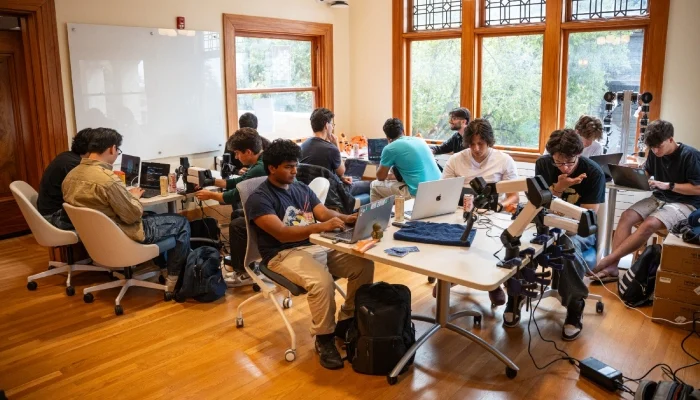
Pakistani robotics data startup World Context held its first hackathon at UC Berkeley, where 13 student teams built projects using recordings of Pakistani factory workers. The event shows how emerging economies are finding a place in physical AI by supplying the human demonstration data robots need to learn real-world tasks.
[For more news, click here]
In a Pakistani factory, workers wearing sensor equipment handle fabric, tools, and parts the way they always have, while their movements are recorded and packaged into a dataset. At the University of California, Berkeley, student engineers recently used such footage to teach a robot to sort objects on a table.
World Context, a startup founded in Pakistan in January that records how people perform physical work and sells the results to robotics companies. The company held its first robotics hackathon at UC Berkeley in partnership with Blockchain at Berkeley, drawing 13 teams that competed across hardware, software, and visualization tracks. Sponsors included Google Gemini, ElevenLabs, The Hackathon Company, Lovable, Praxis Robotics, and UC Berkeley Startup.
Sortbot took the hardware prize for robots that sort different types of objects. Reconstructors won the software track by rebuilding World Context recordings in the physical world, then won visualization with a simulation drawn from the same work along with $4,500 in cash prizes.
Language models learned from the internet, but robots have no equivalent library. A machine that grips a wrench or folds a shirt needs recorded examples of human hands doing those things in real settings. Berkeley roboticist Ken Goldberg has described this as a "100,000-year data gap," a way of measuring how little physical experience exists in digital form compared with text.
Robotics startups raised $18.8 billion globally by mid-June 2026, already above the $15 billion raised in all of 2025, according to Crunchbase. Some of it is flowing to data suppliers such as XDOF, a UC Berkeley spinout that raised $70 million this summer, while India's Human Archive is recruiting gig workers to film everyday tasks.
World Context says it gathers data from roughly 8,000 workers across textile, automotive, logistics, and other manufacturing operations, and sells datasets to robotics companies in the United States and China. Manufacturing accounts for 14.8 percent of employment in Pakistan, according to the country's latest Labour Force Survey, giving the company a deep pool of skilled manual work to record.
In August, the startup partnered with Multinet Pakistan for the cloud, storage, and fiber capacity needed to move large video files to overseas clients. Founder and Chief Executive Sherdil Ali Khan has argued that Pakistan's first meaningful contribution to the AI economy will come from supplying training data rather than building frontier models.
Khan said the quality of the submissions was among the event's biggest surprises, and that students used the datasets in ways the company had not anticipated.
“The talent on display at Berkeley showed how advanced the industry is in the U.S., and that there are tremendous opportunities to learn from and partner with U.S. institutions and companies,” Khan said. “We can bring these learnings back to Pakistan to improve the state of technology there as well.”
Khan also met American robotics and computer vision companies to discuss Vision-Language-Action systems, data collection, and hardware deployment. World Context plans similar events with other leading universities.
Pakistan's IT exports reached a record $4.6 billion in the fiscal year ending June 2026, though most of that still comes from software services and freelancing. The National AI Policy approved in July 2025 targets training about one million learners by 2027, though the Digital Rights Foundation has pointed out that its enforcement structure remains thin. Domestic robotics manufacturing is still small, which makes data supply a practical way in.
Recording workers also raises concerns about consent, pay, and privacy, and the footage could one day help automate the jobs it documents. Khan has acknowledged that AI will reshape labor markets regardless and presents the program as extra income for workers.
Global AI Leaders to Headline LEAP 2026 as Riyadh Marks the Year of Artificial Intelligence
How 1001 Raised $30 Million to Bring Sovereign AI to Ports, Airports and Energy Grids
Related Articles


