

AI
Sep 25, 2026
AI
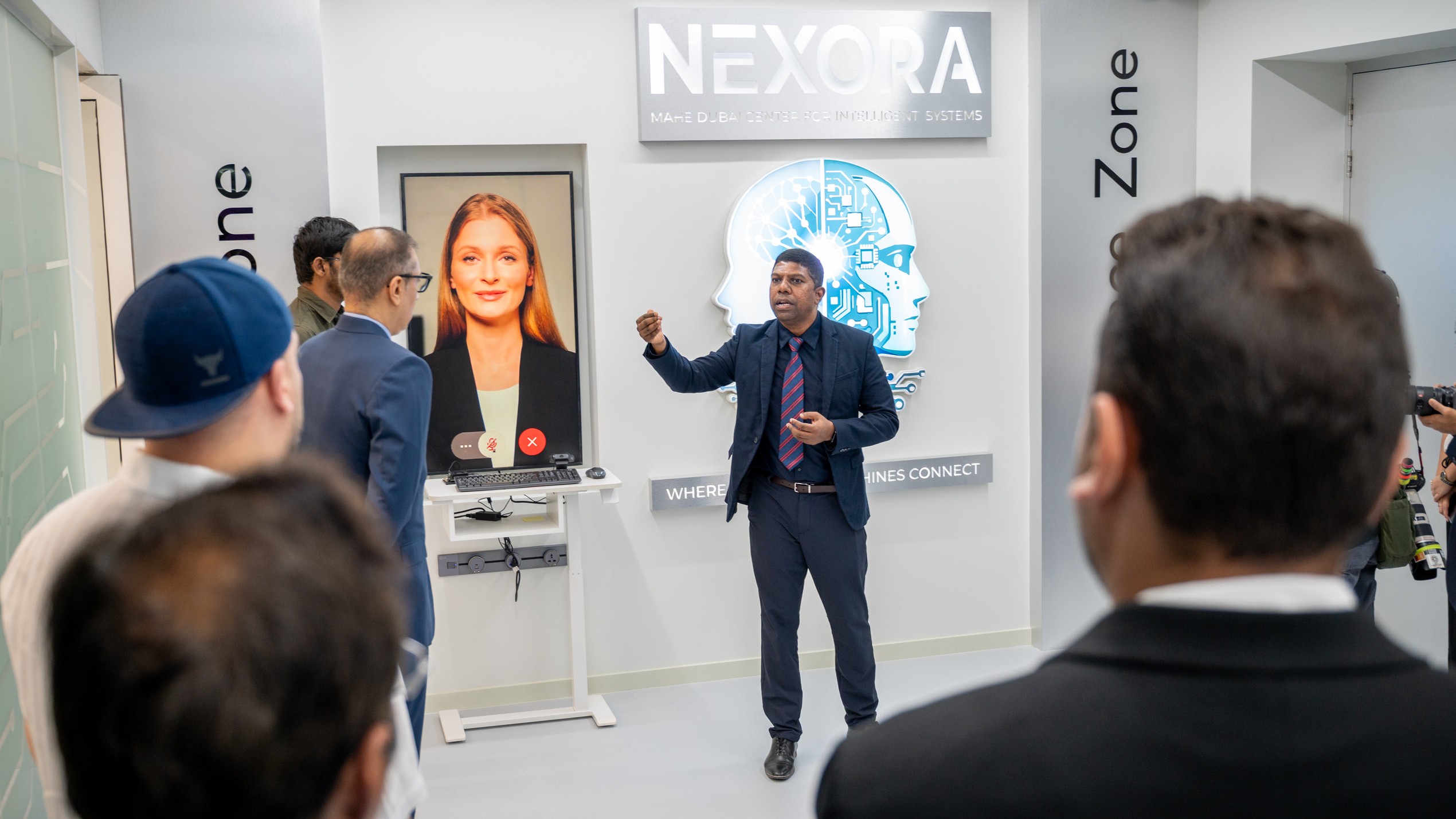
Dubai just unveiled an AI lab where students do not study artificial intelligence — they ship it. In a country racing to make AI 14% of its GDP, MAHE Dubai's NEXORA might be the most consequential room on any university campus in the region.
by Kasun Illankoon, Editor in Chief at Tech Revolt
Walk into most university computer labs and you will find the same thing: rows of workstations, a whiteboard, maybe a server rack humming in the corner. Students arrive, complete assigned tasks, and leave. The gap between what happens in that room and what happens in an actual technology company is vast, quietly understood by everyone, and almost never acknowledged out loud.
NEXORA, the new artificial intelligence lab launched by Manipal Academy of Higher Education (MAHE) at its Dubai campus, was designed with that gap specifically in mind. And if the student demonstrations at its launch event are any indication, the gap is closing faster than most people expected.
The lab opened this month against a backdrop that makes its timing feel less like a coincidence and more like a calculated institutional response to an economic emergency. The UAE's AI market is currently valued at over $3.47 billion and is projected to grow at nearly 44% annually through 2030. The government has set an ambition for artificial intelligence to contribute up to 14% of the country's GDP. Starting in the 2025 to 2026 academic year, AI is being formally introduced into school curricula nationwide. The message from the top has been consistent and loud: the UAE is not interested in consuming the AI revolution from the sidelines. It intends to help lead it.
The problem, as with most technology revolutions, is the talent gap. Ambition is easy. Engineers who can actually build, deploy, and iterate on AI systems in domain-specific contexts are considerably harder to find. NEXORA is MAHE Dubai's answer to that problem.
Most AI education is organized around a familiar question: do students understand how this works? NEXORA is organized around a different one: can students build something with it?
The distinction sounds simple. The implications are substantial. The lab is structured across dedicated zones for ideation, learning, development, and experience, creating an environment where students can move from initial concept through to working prototype and real-world deployment without leaving the building. High-performance computing systems support large-scale model development. Edge AI platforms enable real-time intelligence. Cloud-integrated environments allow for scalable experimentation. Industry-standard frameworks are embedded throughout, meaning students are working with the same tools they would encounter inside a technology company on their first day of employment.
"The conversation around artificial intelligence has moved from awareness to application," said Dr. S. Sudhindra, Pro Vice Chancellor of MAHE Dubai. "The real differentiator today is not access to tools, but the ability to apply them in meaningful, domain-specific contexts."
That framing matters. Access to AI tools in 2026 is not the scarce resource it was even three years ago. The scarce resource now is the ability to take those tools and do something genuinely useful with them in a specific industry context, whether that is healthcare, retail, logistics, or finance. Building that capability requires a different kind of educational environment than a lecture hall or a standard lab session — one where real constraints, real data, and real consequences are part of the learning experience.
The most revealing moment of any technology program is not the curriculum deck or the faculty credentials. It is what students actually produce when given the resources and the expectation to build.
At NEXORA's launch, the demonstrations were striking. Students showcased interactive virtual avatars designed for visitor engagement — the kind of application that hospitality and events companies are actively spending money to develop. They built real-time facial recognition systems operating on edge devices, engineered to process data locally rather than sending it to a central server, a design decision that directly addresses the data privacy concerns that have slowed adoption of similar technologies in enterprise environments. They developed intelligent retail inventory solutions targeting the on-shelf availability problem that costs the retail industry billions annually.
Additional projects included sentiment analysis kiosks, voice-based biometric systems, and interactive learning platforms. Taken together, the student work covered customer experience, retail operations, and enterprise technology — three of the sectors most actively investing in AI deployment across the region.
These are not student experiments in the traditional sense. They are prototypes that address problems companies are paying consultants significant sums to solve. The fact that they emerged from a university lab, built by students rather than seasoned engineers, is the point MAHE Dubai is making with NEXORA: given the right environment, the talent gap is smaller than it looks.
One of the more thoughtful design decisions behind NEXORA is its cross-disciplinary scope. AI labs at universities have historically been housed within computer science or engineering departments, which creates a subtle but consequential problem. The students who graduate from those programs understand how to build AI systems. They often have a less developed understanding of the business contexts, regulatory environments, and human factors that determine whether those systems actually get adopted.
NEXORA extends its reach into management, health sciences, media, and other academic domains. The underlying argument is that AI is not a specialist tool anymore — it is becoming a foundational capability across every professional field, in the same way spreadsheet literacy became foundational in the 1990s or internet literacy in the 2000s. A health sciences student who understands how to work with AI diagnostic tools, or a media student who can deploy AI-driven content personalization, is a more complete professional than one who cannot.
"AI cannot be taught effectively in isolation from its application," said Dr. Balamurugan Balusamy, Dean and Professor at the School of Engineering and IT. "Students are working with real data, real constraints, and real use cases, which fundamentally changes how they understand and apply AI."
The lab is also intended to become a hub for research and industry collaboration, with faculty-led projects and partnerships with companies operating in the region. MAHE Dubai has also signaled plans to add a quantum computing terminal, positioning NEXORA not just as a response to the current AI moment but as infrastructure for whatever comes next.
The UAE has made a habit of moving quickly when it identifies a strategic priority, and AI is as clear a strategic priority as the country has named in recent years. The combination of government investment, curriculum reform, and institutional initiatives like NEXORA suggests a coordinated approach that goes beyond headline announcements.
What makes NEXORA notable within that broader context is the specificity of its ambition. It is not trying to teach students that AI exists, or to give them a theoretical foundation they can build on later. It is trying to produce graduates who can walk into an employer on day one and begin contributing to AI projects that are already underway. In a market where the gap between AI ambition and AI execution is still wide, that specificity is exactly what is needed.
The UAE has set the destination. Labs like NEXORA are where the journey actually begins.
Related Articles


