

MENA News
Oct 9, 2026
MENA News
As Dubai's financial technology sector moves its AI agents out of pilots and into production, engineers and executives say the deciding factor is not model quality but the discipline of keeping a human accountable for every decision a machine makes.
by Kasun Illankoon, Editor in Chief at Tech Revolt
[For more news, click here]
Financial technology companies in the Gulf have spent the past two years racing to deploy artificial intelligence that can act on its own, approving loans, flagging fraud, and answering customer questions without a person in the loop for every step. The harder problem, according to engineers and executives who gathered recently at the FinTech Hive at the DIFC Innovation Hub in Dubai, has turned out to be something far less glamorous than the models themselves: building the organizational muscle to supervise machines that never get tired, never second-guess themselves, and never actually bear the consequences when something goes wrong.
That argument, delivered at an event titled “From Pilot to Production: Building the Foundations for Agentic AI in MENA FinTech,” marks a notable shift in how the region's technology leaders are talking about automation. Rather than selling agentic AI as a labor-saving miracle, the session's speakers spent their time on the unglamorous engineering work, evaluation pipelines, governance layers, and infrastructure planning, that separates a fintech company running AI safely at scale from one merely experimenting with it.
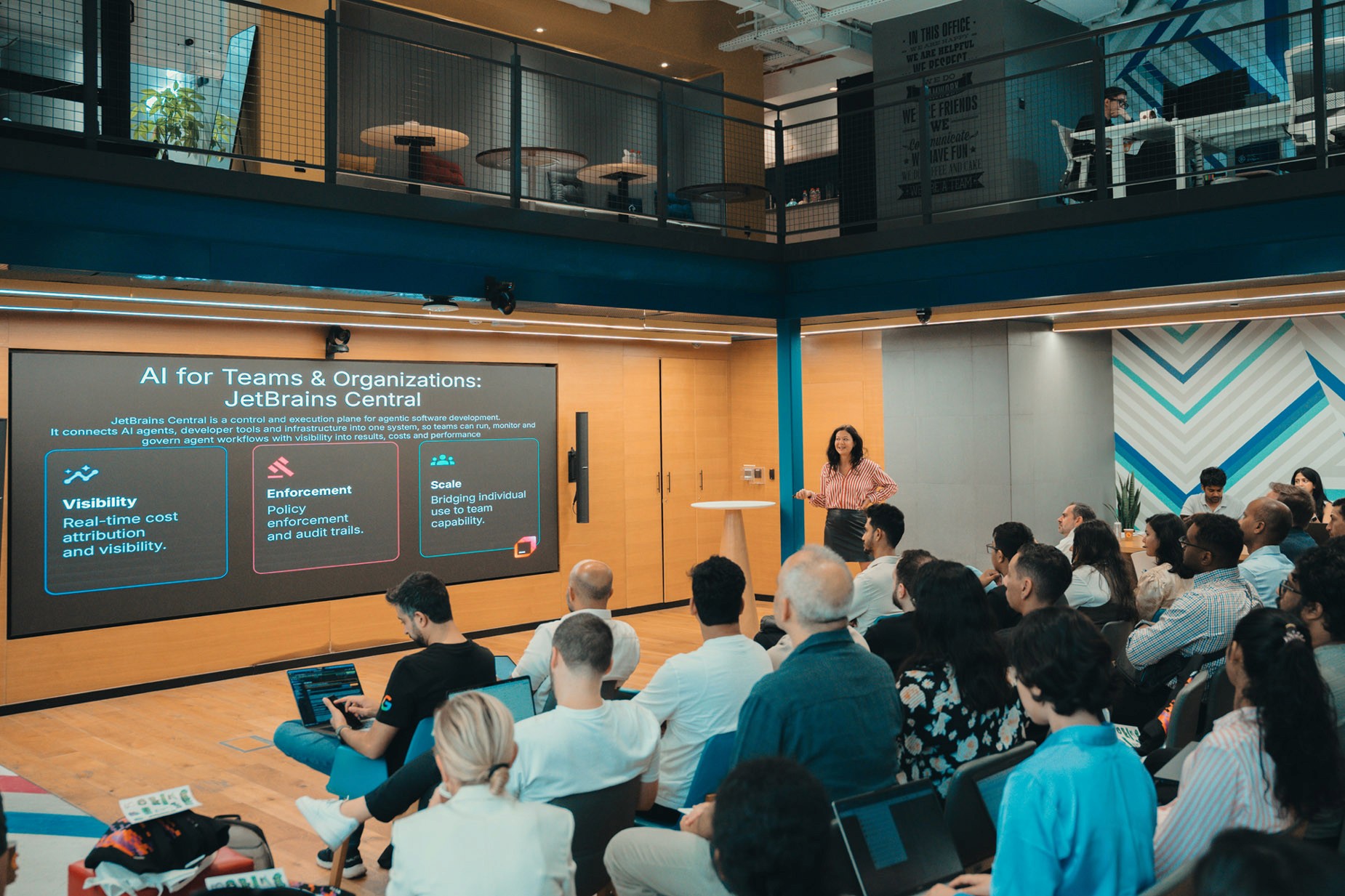
The panel brought together JetBrains MENA, Tabby, and Google for Developers, hosted at the DIFC Innovation Hub in Dubai.
The urgency behind the conversation is easy to trace. The UAE has built its economic strategy around becoming a global reference point for AI adoption, and the Dubai International Financial Centre has become one of the clearest places to watch that strategy play out in a regulated industry. According to the Dubai Financial Services Authority's most recent AI survey, more than half of authorized firms within the DIFC are already using AI, up from roughly one-third the year before, with generative AI adoption nearly tripling over the same period.
Numbers like that would normally be the headline. At this event, they were treated as the given, the backdrop against which a more consequential question was being asked: now that adoption has arrived, what keeps it from breaking?
The clearest answer came from Nadia Rinsky, Head of MENA GTM at JetBrains, who argued that the technical sophistication of an AI system matters less than the human structure built around it.
“The UAE FinTech sector is uniquely positioned to benefit from progressive regulation and a thriving ecosystem, but as we scale agentic AI, we must confront a fundamental reality: accountability cannot be delegated to a machine, because AI has nothing to lose. When production breaks in a critical financial system, the human developer still gets the call. For JetBrains, the real progress isn't just about cheap code generation; it's about code control. The developer's role is shifting toward directing, supervising, and verifying teams of intelligent agents. Our focus is providing the professional tools that act as an immune system against AI-generated complexity, ensuring engineers can confidently sign off on the code they merge.”
That framing recasts human oversight not as a brake on innovation but as the mechanism that makes faster deployment possible in the first place. An engineer who can verify what an AI agent produced, rather than simply trusting it, is an engineer who can approve more of it, more quickly.
Much of the region's early AI activity has looked like individual developers experimenting with tools on their own laptops. JetBrains used the session to lay out what it described as the next phase: a structured, team-wide capability rather than a patchwork of personal habits. Drawing on twenty-five years in code intelligence, the company pointed to JetBrains Central as a control plane for engineering teams, covering model policy enforcement, cost attribution, and workflow auditability.
The pitch is a reframing of governance itself. Centralized oversight is usually described as a constraint that slows teams down. JetBrains argued the opposite: that clear rules about which models can be used, what they cost, and how their output is tracked are precisely what let developers move faster, because nobody has to stop and ask permission for every individual decision.
For a live example of what this looks like in practice, the room turned to Tabby, the buy-now-pay-later platform that has become one of the region's largest shopping and financial services apps. Denis Sakhnov, Tabby's Head of AI Agent Platform, walked through where the company has chosen to deploy autonomous systems: operations, customer-facing products, and the software development lifecycle.
Within financial services specifically, Sakhnov pointed to anti-fraud checks, know-your-customer verification, and customer support as strong candidates for automation, precisely because they are repetitive, high-volume tasks. But he was careful to note that none of it works without a parallel structure for human-led approval and evaluation sitting alongside the automation, particularly in a business that operates under real regulatory scrutiny and handles other people's money.
The infrastructure question, how to actually host and run these systems reliably, fell to Majd Jamaah, Head of Cloud and DevOps at Beyond AI and a Google Developer Expert. Jamaah mapped out the enterprise-scale architecture required to turn what he called fragile proofs-of-concept into dependable production pipelines.
His central lesson was one of restraint rather than ambition: design for variability, traffic, cost, and latency from the outset, and resist the urge to over-engineer before real usage has revealed where the actual limits are. Start simple, in other words, and let production traffic, not a roadmap deck, decide where to add complexity.
None of this is unique to Dubai. Financial institutions in New York, London, and Singapore are wrestling with the same tension between the promise of autonomous AI and the liability of letting it act unsupervised. What makes the DIFC conversation notable is the confidence with which its participants treated governance as a growth strategy rather than a compliance afterthought, a position that boards in North America are only beginning to formalize, and one that GCC regulators, with the DFSA's own adoption survey as evidence, appear increasingly comfortable encouraging rather than restraining.
The takeaway from the FinTech Hive gathering was ultimately an optimistic one: agentic AI in financial services does not have to choose between speed and safety. Done well, according to the engineers and executives closest to the work, the discipline of keeping a human in charge of the outcome is what allows the technology to scale at all.
Inside the OpenAI-Hugging Face Security Incident Reshaping How AI Rivals Collaborate on Safety
Why the Price of an AI Token Doesn't Tell You What AI Actually Costs
Related Articles