
AI
Oct 2, 2026
Exclusive: An AI Just Passed a Video Turing Test. What Happens When You Cannot Tell Who is on the Call?
AI
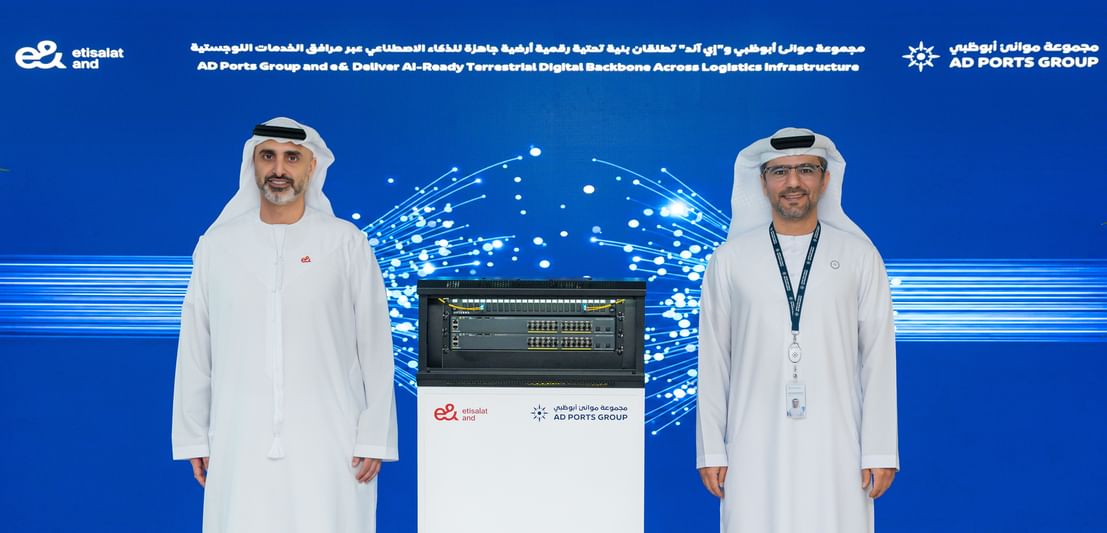
A 1,000-kilometre AI-ready terrestrial network now connects Abu Dhabi's major maritime and logistics assets. It is not just a connectivity upgrade. It is a bet that the future of global trade runs on real-time data.
by Kasun Illankoon, Editor in Chief at Tech Revolt
AD Ports Group and e& UAE have deployed a high-capacity terrestrial network spanning more than 1,000 kilometres across Abu Dhabi's maritime and logistics assets. The network is live, it connects the Group's major facilities across the emirate, and it was built with one specific purpose: to give AI systems the data infrastructure they need to actually work at port scale.
Ports are not quiet places. A modern, active terminal generates continuous streams of sensor telemetry, high-definition video surveillance, crane and vessel positioning signals, environmental monitoring data, and increasingly, real-time inputs from autonomous systems. Moving all of that data reliably, at scale, and with the kind of latency that allows AI models to act on it meaningfully, has been one of the quiet engineering problems sitting beneath every conversation about the smart port of the future.
What AD Ports Group and e& UAE have built addresses that problem directly. The new network is designed for ultra-low latency and high bandwidth, creating what both organisations describe as a foundation for AI models to process data and deliver real-time inference within milliseconds. That last phrase is worth pausing on. Milliseconds matter when the system in question is coordinating vessel arrivals, managing autonomous ground vehicles across a terminal, or flagging anomalies in cargo handling before they become costly errors.
"The future of global trade is intelligent and predictive. Under the guidance of our wise leadership in the UAE, we are embracing and leading this change by collaborating with globally leading technology companies to help us ensure that digital intelligence remains at the heart of our operations, driving global trade and supply chain resilience," Captain Mohamed Juma Al Shamisi, Managing Director and Group CEO, AD Ports Group
The angle that makes this story interesting is not just the scale of the investment. It is the architecture behind it. AD Ports Group is not building a single-layer digital nervous system. It is building a multi-layered one, and this terrestrial network is the latest component to snap into place.
In 2025, the Group announced a phased rollout of Low Earth Orbit (LEO) satellite connectivity across its global operations, specifically aimed at enabling real-time data exchange with vessels at sea and delivering always-on connectivity for ports and terminals that cannot rely solely on fixed infrastructure. That programme brought satellite connectivity into the picture. The new terrestrial backbone now joins it, alongside existing radio networks, to create what the Group calls a resilient, multi-layered connectivity architecture, one capable of maintaining uninterrupted, sovereign data flow across all conditions.
The word sovereign is deliberate and increasingly important in conversations about critical national infrastructure. For a port group managing assets that sit at the intersection of logistics, energy, and international trade, the ability to maintain control of data flows, regardless of external network conditions, is not a technical preference. It is a strategic imperative.
From e& UAE's perspective, this deployment represents a different kind of statement. Telecommunications operators have spent years making the case that connectivity is infrastructure, in the same category of strategic national importance as roads, electricity grids, and water systems. This project illustrates that argument in concrete terms.
"Advanced connectivity is now essential to the way major industrial and logistics hubs operate, scale and compete. Through this collaboration with AD Ports Group, e& UAE has delivered a future-ready digital backbone that powers speed, security and scalability, while creating the foundation for more advanced automation, analytics and AI-led operations," said Masood M. Sharif Mahmood, Group CEO of e& and CEO of e& UAE
Mahmood's framing goes further still. "With e&'s leadership in fibre connectivity, we are not just connecting infrastructure; we are shaping the future of trade, logistics, and innovation for the entire nation." That is a significant claim, but in context it has real weight. The UAE's economic diversification strategy places logistics and trade facilitation at its centre, and the infrastructure that enables automated, AI-optimised port operations is not peripheral to that ambition. It is load-bearing.
For companies and cargo owners using AD Ports Group's facilities, the practical implications are gradual but cumulative. Better connectivity at the infrastructure layer means more reliable data at the operational layer, which means AI systems for vessel scheduling, cargo tracking, and logistics coordination can perform with greater accuracy and fewer interruptions. The efficiency gains that follow, from faster turnaround times to reduced fuel consumption to lower dwell times for containers, flow through the entire supply chain.
The UAE has spent years positioning itself as a global logistics hub, and the investments that support that positioning are rarely visible in a single announcement. They accumulate. A fibre backbone here. A LEO satellite network there. A data integration layer that ties them together. What AD Ports Group is building, methodically and at genuine scale, is the substrate on which the next generation of port operations will run. The partnership with e& UAE is not an endpoint. It is, in the clearest sense, a foundation.
Why Trust Has Become the Most Valuable Currency in MENA's Digital Payment Revolution
Policy, Diplomacy and the Quiet Work of Making Europe Competitive Again
Why YouTube’s FIFA World Cup Deal Could Signals the Beginning of the End for TV Broadcasters
Related Articles